
Quick answer
Your AP Lang score is 45% multiple choice (45 questions) and 55% essays (three essays scored 0–6). The two parts make a composite out of 100. Each essay point is worth about 3 multiple-choice questions. On our estimate, about 53 is a 3, 67 a 4 and 79 a 5.
In this AP Lang grade calculator guide:
- How the calculator works
- Exam format
- Methodology
- The composite formula
- From a 4 to a 5
- Estimated cut-offs
- What the essay rubric rewards
- Confusion, cleared
- 2026 results
- Common mistakes
- Who should use it
- Where you’ll use this
- Practice problems
- FAQs
- Conclusion

Key takeaways
- 45 multiple-choice questions = 45 composite points; 18 essay points = 55 composite points.
- One essay point ≈ 3.06 composite points — about three multiple-choice questions.
- Synthesis, rhetorical analysis and argument essays are each scored 0–6.
- In 2026, 75% of AP Lang students scored 3 or higher.
On this page
- How the AP Lang grade calculator works
- AP English Language exam format (May 2027)
- Methodology: how we built these estimates
- The composite formula
- From a 4 to a 5: the per-step maths
- Estimated cut-offs
- Confusion, cleared
- What the essay rubric rewards
- 2026 results
- Common mistakes, and what to do instead
- Who should use this guide, and its limits
- Where you’ll use this
- Practice problems (with answers)
- Frequently asked questions
- Conclusion
- Sources
Looking for an AP Lang grade calculator? The math is simpler than most AP exams: two parts, fixed weights. Here is how to estimate your score and where to focus.
Written and reviewed by the PercentPilot Editorial Team · Updated 21 November 2026 · Free tool — no signup, no login.
AP Lang Score CalculatorSet your MCQ score and tap your 0–6 essay scores.Open →How the AP Lang grade calculator works
An AP Lang grade calculator takes two inputs — your multiple-choice score out of 45 and your three essay scores, each 0–6 — and turns them into one composite out of 100, which maps to an estimated AP score from 1 to 5. The same method powers the AP Lang Score Calculator.
Use this guide after a timed practice test, when you have real scores to enter. Guessing essay scores is the weakest link: most students mark their own essays a point or two higher than a teacher would. A good estimate needs timed practice scores, the official rubric, and the current format.
The method is the same across AP subjects — only the weights change. See the AP Bio score guide and the AP Stats score guide for the same idea on other exams.
AP English Language exam format (May 2027)
| Section | Questions | Time | Weight |
|---|---|---|---|
| Multiple choice | 45 (23–25 reading, 20–22 writing) | 60 min | 45% |
| Free response | 3 essays (0–6 each) | 2 h 15 min incl. 15 min reading | 55% |
Methodology: how we built these estimates
Every figure in this guide comes from College Board: the AP English Language exam page (45 MCQs at 45%, three essays at 55%), the course overview (PDF) (the 0–1, 0–4, 0–1 rubric rows), and the 2026 score distributions. The cut-offs are our estimates, built from that distribution and the composite maths — College Board does not publish exact cut-offs.
We re-check this page when College Board publishes new distributions. Last updated 21 November 2026.
Expert review pending
This guide was written and checked by the PercentPilot Editorial Team. A review by an AP English teacher is pending.
The composite formula
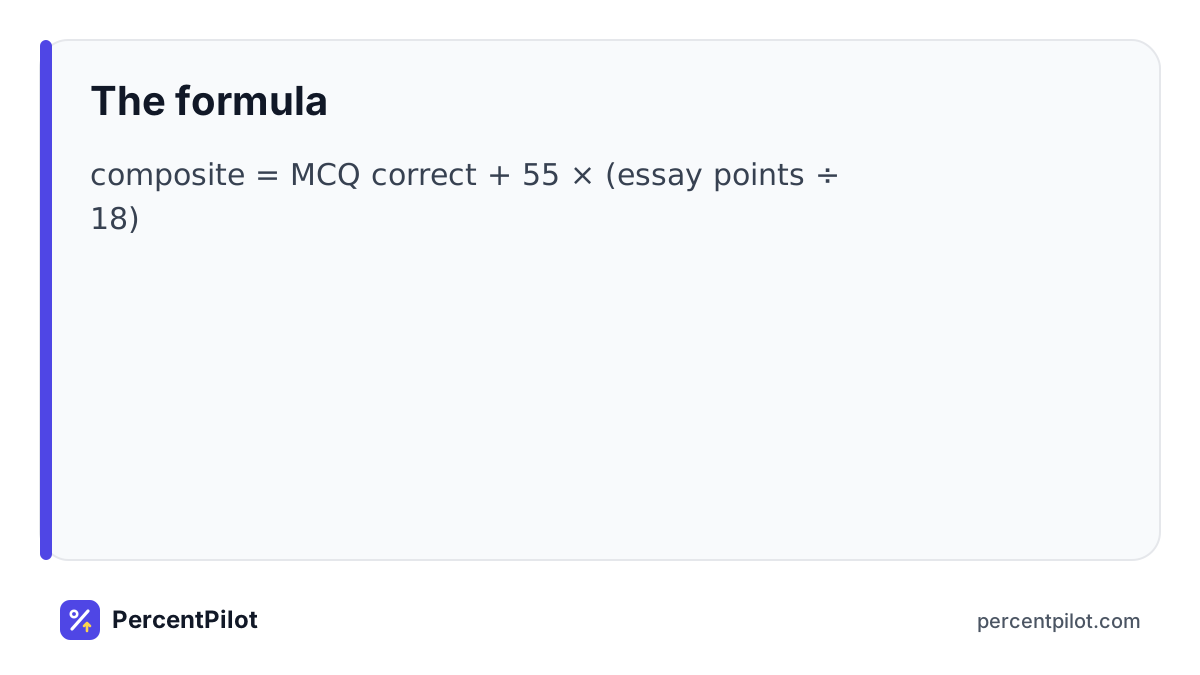
composite = MCQ correct + 55 × (essay points ÷ 18)
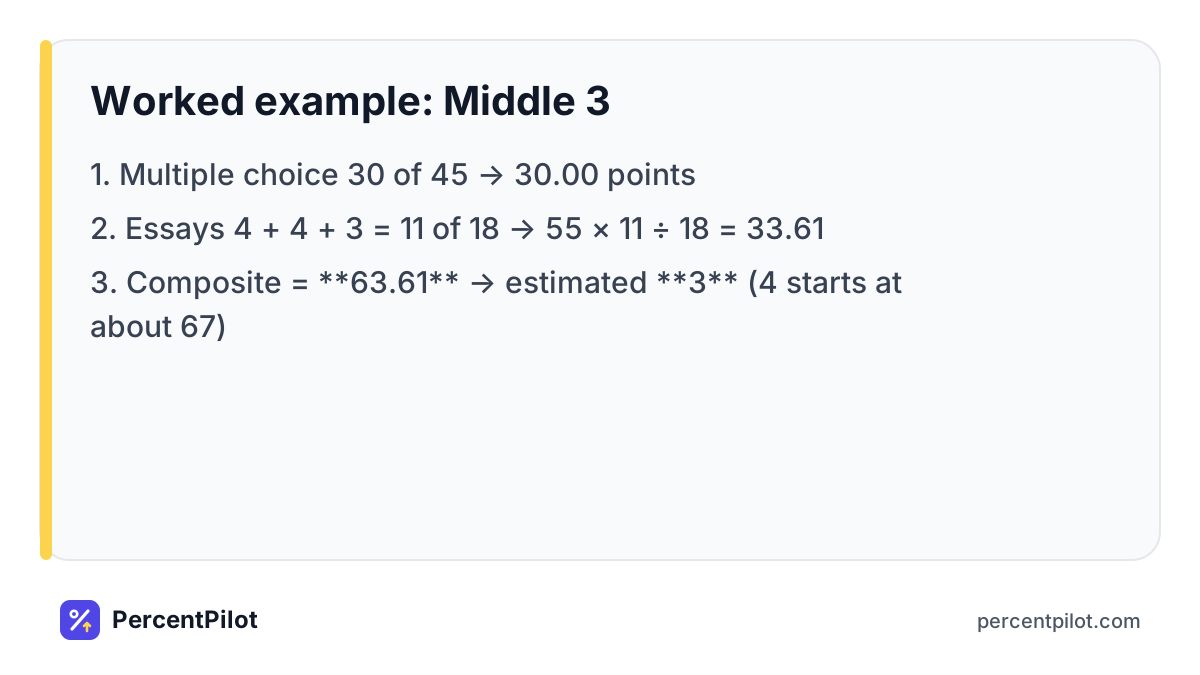
Worked example: Middle 3
- Multiple choice 30 of 45 → 30.00 points
- Essays 4 + 4 + 3 = 11 of 18 → 55 × 11 ÷ 18 = 33.61
- Composite = 63.61 → estimated 3 (4 starts at about 67)
Worked example: From a 3 to a 4
- Gap to 67: 67 − 63.61 = 3.39 points
- One more essay point adds 3.06 → 66.67, still short
- One essay point plus one more MCQ → 67.67 → estimated 4

From a 4 to a 5: the per-step maths
Here is the smallest realistic step from a 4 to a 5, worked one step at a time:
| Step | What you do | Numbers | Running total |
|---|---|---|---|
| 1 | Count the multiple-choice score | 38 of 45 | 38.00 |
| 2 | Add the three essay scores | 5 + 5 + 4 = 14 of 18 | — |
| 3 | Convert the essays | 55 × 14 ÷ 18 = 42.78 | 38 + 42.78 = 80.78 |
| 4 | Read the cut-off | 80.78 is above 79 | Estimated 5 |
Worked example — your teacher’s rubric scores may differ slightly, so use official scoring guidelines where you can. One more essay point plus one more MCQ is the smallest step across this line.
Estimated cut-offs
- 5: about 79+
- 4: about 67–78
- 3: about 53–66
- 2: about 38–52
- 1: below about 38
Accuracy first
Essay scores are the biggest lever and the hardest to predict. When you practice, have a teacher or classmate score your essay with the official rubric so your estimate uses realistic essay points.
Confusion, cleared
Grade calculator or score calculator?
The same thing, here. Some students search for an “AP Lang grade calculator” and others for a “score calculator” — both mean a tool that estimates the 1–5 AP score from practice results. This guide uses both phrases so either search finds it.
Composite points are not raw marks
The 45% multiple-choice weight means 45 of the 100 composite points — one MCQ is worth exactly 1 composite point, while one essay point is worth 3.06 (55 ÷ 18). So one more MCQ adds 1 point out of 100, not 1% of your grade.
AP Lang is not AP Lit
AP English Language tests rhetoric and argument in non-fiction; AP English Literature tests literature. Different exams, different rubrics, different cut-offs — do not use one exam’s numbers for the other. The scales do not convert either: AP scores run 1–5, IB grades run 1–7, UK A-levels run A*–E.
What the essay rubric rewards
Each essay is scored in three rows: thesis (0–1), evidence and commentary (0–4) and sophistication (0–1). Most points sit in the evidence and commentary row. Explaining how your evidence supports your claim is what moves a 3 to a 4 on that row.
2026 results
In 2026, 15% scored a 5, 28% a 4, 32% a 3, 15% a 2 and 10% a 1 — 75% scored 3 or higher.
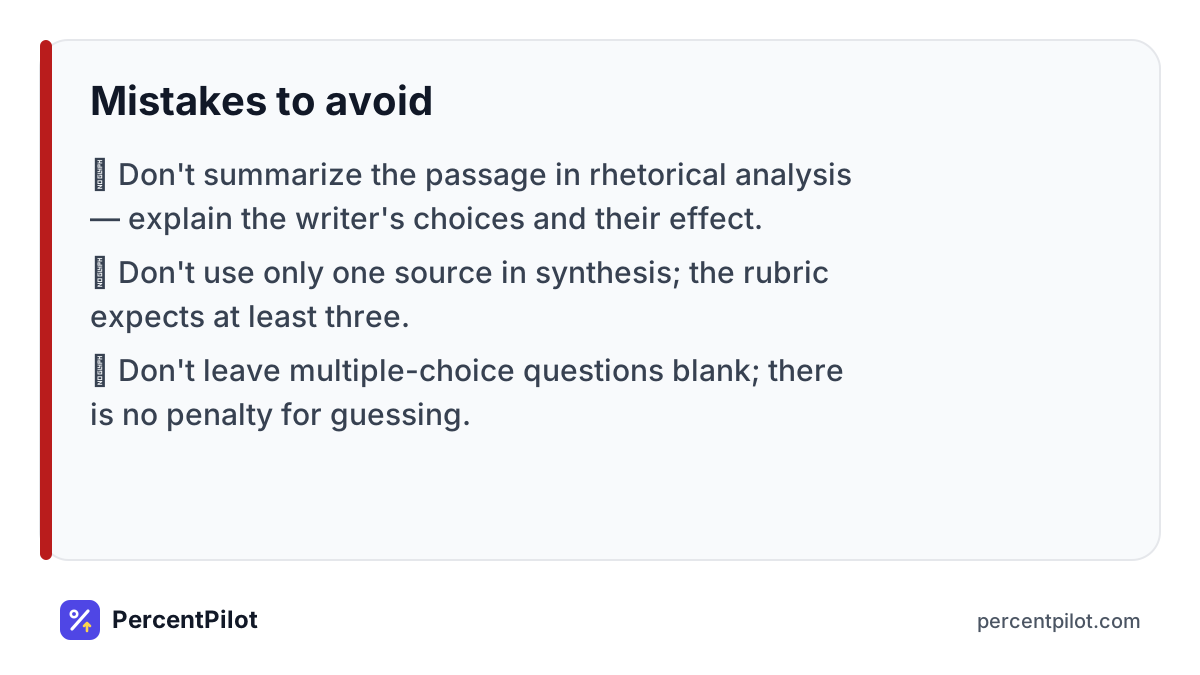
What NOT to do
- Don’t summarize the passage in rhetorical analysis — explain the writer’s choices and their effect.
- Don’t use only one source in synthesis; the rubric expects at least three.
- Don’t leave multiple-choice questions blank; there is no penalty for guessing.
Common mistakes, and what to do instead
Four mistakes show up again and again. First, trusting one practice test: scores move a few points between mocks, so average two or three timed tests. Second, marking your own essays generously: most students add a point or two per essay — have a teacher score at least one set with the official rubric. Third, forgetting the reading time: 15 of the 135 free-response minutes are reading time. Fourth, treating the estimate as a promise: a 67 is a borderline 4, not a safe one.
Fix the biggest leak first: for most students it is the evidence and commentary row (0–4). Explaining how each piece of evidence supports the claim is worth more than any other single change.
Related: APUSH score guide, how AP exams are scored, and the full list of AP calculators.
Who should use this guide, and its limits
Who should use it
AP Lang students with timed practice scores, teachers checking a class’s spread, and parents helping a student plan.
Where it falls short
Three honest limits. The cut-offs are estimates — College Board does not publish exact cut-offs, and no two years share them exactly. Essay self-scoring is unreliable, so an estimate built on guessed essay scores can be off by a full grade. And we have not verified this against every teacher’s rubric. Always confirm a borderline result with your teacher before you act on it.
Where you’ll use this
Your teacher hands back a practice exam: 33 of 45 multiple choice and essays scored 4, 3 and 4. Your composite is 33 + 55 × 11 ÷ 18 = 66.61 — less than half a point under our estimated line for a 4 on the May 2027 exam.
That is the most common AP Lang situation: the multiple choice is solid, and one essay point decides the score. Look at which row of the rubric you lost points on. Most students lose them in evidence and commentary (0–4), so practice explaining how each piece of evidence supports your claim — one more point there is worth about three multiple-choice questions.
Practice problems (with answers)
Try each one, then check it with the AP Lang Score Calculator. More tools: all AP & IB score calculators.
- Estimate the score: Multiple choice 36; Essays 13 (5 + 4 + 4). Answer: Multiple choice: 36/45 × 45 = 36 · Essays: 13/18 × 55 = 39.72 → composite 75.72 → estimated 4.
- Estimate the score: Multiple choice 28; Essays 10 (3 + 4 + 3). Answer: Multiple choice: 28/45 × 45 = 28 · Essays: 10/18 × 55 = 30.56 → composite 58.56 → estimated 3.
- Estimate the score: Multiple choice 22; Essays 8 (3 + 2 + 3). Answer: Multiple choice: 22/45 × 45 = 22 · Essays: 8/18 × 55 = 24.44 → composite 46.44 → estimated 2.
Frequently asked questions
Is AP Lang hard to pass?
It is one of the more passable AP exams: 75% of students scored 3 or higher in 2026.
How many points is each AP Lang essay?
Each essay is scored from 0 to 6, for 18 essay points in total.
How much is an essay point worth on AP Lang?
About 3.06 composite points (55 ÷ 18), compared with 1 point per multiple-choice question.
What is a good AP Lang score?
A 4 or 5 earns college credit at most US colleges, and a 3 earns credit at many. Each college sets its own minimum — check the AP credit policy of the colleges on your list.
Can I get a 5 with weak essays?
Almost certainly not. The essays are 55% of the score: even with all 45 MCQs right, essays of 3, 3 and 3 give 45 + 27.50 = 72.50 — a 4, not a 5. You need about 79 for a 5.
Does AP Lang use a curve?
Not in the usual sense. College Board sets the 1–5 cut-offs each year after scoring, using standard-setting — so they move a little from year to year, and ours are estimates.
How do I use the AP Lang grade calculator?
Enter your multiple-choice score out of 45 and your three essay scores, each 0–6. The calculator builds your composite out of 100 and shows the estimated 1–5 score.
Conclusion
The AP Lang grade calculator is simple once the weights are clear: 45 multiple-choice questions at 45%, three 0–6 essays at 55%, one composite out of 100. About 53 is a 3, 67 a 4 and 79 a 5 on our estimate — and because one essay point is worth about three multiple-choice questions, the essays are where the score moves. Take a timed practice test, score the essays with the official rubric, and work on the rubric row that cost you the most.
Try it now
Put your own numbers into the AP Lang Score Calculator — 45 MCQs and three 0–6 essays — and see your estimated score in seconds. PercentPilot is free, no signup, no login.
Sources
- College Board – AP English Language exam
- College Board – AP score distributions 2026
- College Board – AP English Language course overview (PDF)
Spotted an error? Tell us and we will fix it and note the change here.