
Disclosure: This page contains affiliate links. If you buy through them, we may earn a commission at no extra cost to you. As an Amazon Associate I earn from qualifying purchases.
An AP bio grade calculator turns your multiple-choice and free-response points into a 1–5. This guide shows the weights behind it, so you can estimate your score by hand.
Quick answer
Your AP Bio score comes from two equal halves: 60 multiple-choice questions (50%) and 6 free-response questions (50%). The two halves add up to a composite out of 100, and College Board turns that into a 1–5. On our estimate, about 45 is a 3, 59 is a 4 and 73 is a 5.
Key takeaways
- Multiple choice and free response are each worth exactly half of your AP Bio score.
- Each multiple-choice question is worth about 0.83 composite points; each free-response point is worth about 1.47.
- Cut-offs are estimates — College Board sets the real conversion after every exam.
- In 2026, 71% of AP Biology students scored 3 or higher.
On this page
- How the AP bio grade calculator works
- What is on the AP Biology exam?
- How the composite score is calculated
- Estimated cut-offs for 2027
- How did students score in 2026?
- Where extra points help most
- Where you’ll use this
- Common confusions, cleared up
- Practice problems (with answers)
- How we calculated this
- Conclusion: your AP bio grade calculator, in one line
- Frequently asked questions
- Sources
If you searched for an AP Bio grade calculator, you want to know one thing: “What score will I get?” This guide shows exactly how the AP Biology score is built, so you can estimate it yourself and see where extra points help most.
AP Bio Score CalculatorMove a slider and tap your FRQ points to estimate your 1–5.Open →In this guide
How the AP bio grade calculator works
Enter your multiple-choice correct out of 60, and your free-response points out of 34. The calculator turns each half into a share of 50, adds them into a composite out of 100, and shows your estimated 1–5.
What is on the AP Biology exam?
The May 2027 AP Biology exam is 3 hours long and has two sections.
| Section | Questions | Time | Share of score |
|---|---|---|---|
| Multiple choice | 60 | 90 minutes | 50% |
| Free response | 6 (2 long, 4 short) | 90 minutes | 50% |
The long free-response questions are worth 8–10 points each, depending on the year. Short ones are worth 4 points each. Our calculator uses 9 for each long question, for a free-response total of 34 points.
How the composite score is calculated
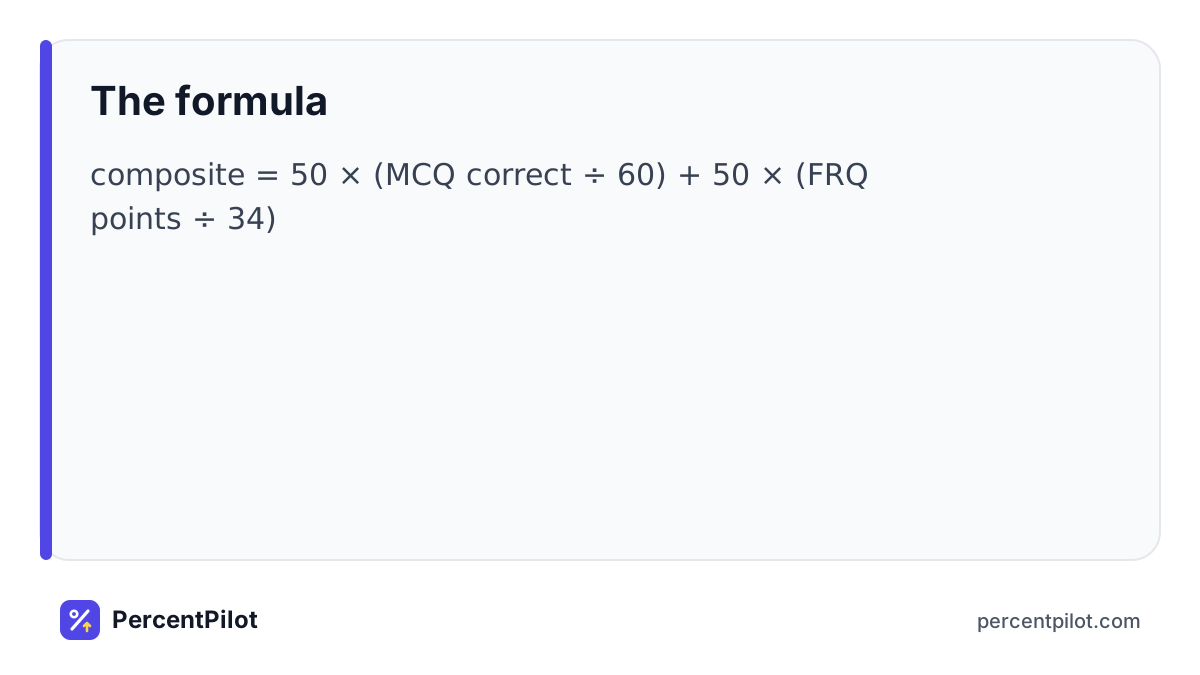
College Board turns each section into a share of 100 and adds them.
composite = 50 × (MCQ correct ÷ 60) + 50 × (FRQ points ÷ 34)
There is no penalty for wrong answers, so leaving a multiple-choice question blank can only cost you.
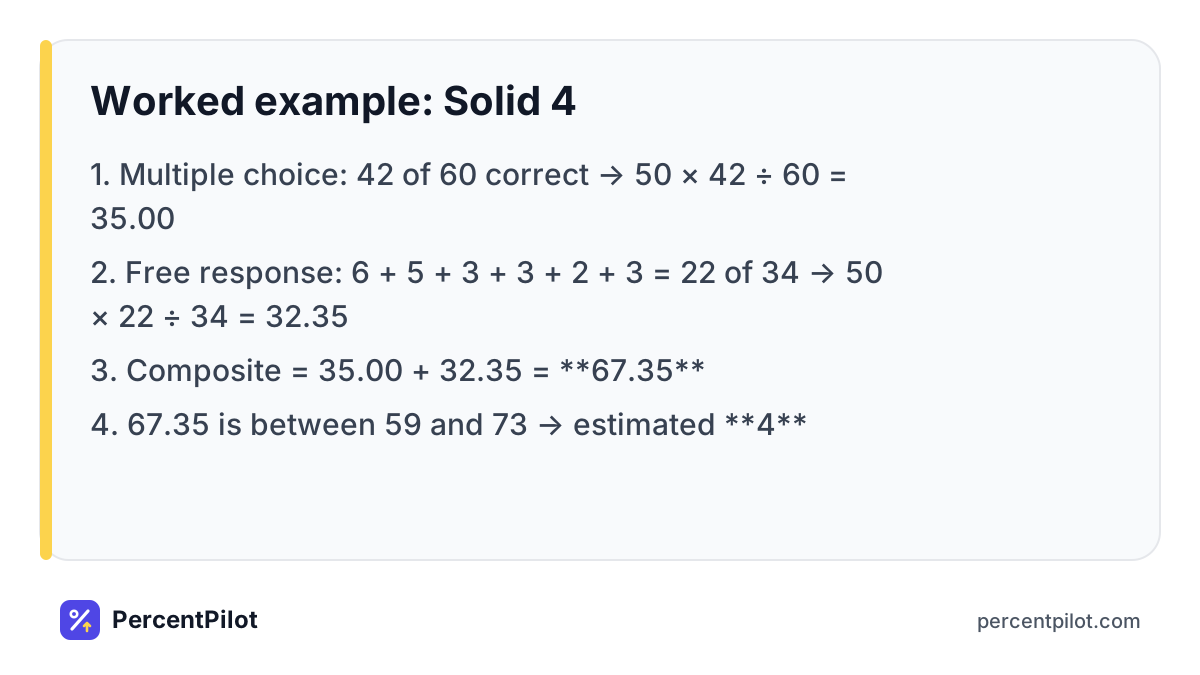
Worked example: Solid 4
- Multiple choice: 42 of 60 correct → 50 × 42 ÷ 60 = 35.00
- Free response: 6 + 5 + 3 + 3 + 2 + 3 = 22 of 34 → 50 × 22 ÷ 34 = 32.35
- Composite = 35.00 + 32.35 = 67.35
- 67.35 is between 59 and 73 → estimated 4
Worked example: Borderline 3
- Multiple choice: 30 of 60 → 25.00
- Free response: 14 of 34 → 50 × 14 ÷ 34 = 20.59
- Composite = 45.59 → just over our estimated line of 45 → a 3
- One more free-response point (+1.47) gives a little safety margin

Estimated cut-offs for 2027
College Board does not publish the conversion table for each recent exam. Our estimates are based on public score distributions and past released tables. Use them as a range, not a promise.
- 5: about 73+ out of 100
- 4: about 59–72
- 3: about 45–58
- 2: about 30–44
- 1: below about 30
Accuracy first
Treat any AP score calculator as an estimate. The curve moves a few points each year, so check your result with the Lenient and Strict buttons and plan for the strict one.
How did students score in 2026?
In 2026, 15% of AP Biology students earned a 5, 25% a 4, 31% a 3, 21% a 2 and 8% a 1. That means 71% earned a 3 or higher, up slightly from 70.4% in 2025.
Where extra points help most
Because each free-response point is worth almost twice as much as one multiple-choice question, practicing the two long questions (interpreting experimental results, including graphing) is usually the fastest way to move up a score. Learn the task verbs — identify, describe, explain, justify — because the rubric awards points for exactly what the verb asks.
A calculator is allowed on both sections. The Bluebook testing app includes a built-in calculator, and College Board’s calculator policy lists which handheld models are allowed if you prefer your own.
If you want a handheld one, check the policy first, then compare models. See graphing calculators on Amazon
What NOT to do
- Don’t leave multiple-choice questions blank — there is no guessing penalty.
- Don’t assume last year’s cut-offs will repeat exactly.
- Don’t spend extra minutes on one hard multiple-choice set; free-response points are worth more.

Want the bigger picture? Read how AP exams are scored, compare with the APUSH score guide, or browse all AP score calculators.
Where you’ll use this
It’s April, and you just finished a full practice exam from AP Classroom. You scored 40 of 60 on the multiple choice and your teacher scored your free responses at 19 of 34. Plug those in: 50 × 40 ÷ 60 = 33.33 and 50 × 19 ÷ 34 = 27.94, for a composite of 61.27 — an estimated 4, but only about 2 points above the line.
That tells you where to spend the next three weeks. Two more free-response points (about 2.94 composite points) do more than three extra multiple-choice questions (2.50). So practice the two long questions, especially graphing and justifying claims with data, and re-take a timed multiple-choice set once a week to keep that score steady.
Common confusions, cleared up
AP score vs class grade
Your AP score (1–5) is not your class grade: your teacher sets the class grade, College Board sets the AP score. Colleges use it for credit — usually 4 or 5 minimum.
Composite vs raw score
Your raw score is what you earned; your composite is the weighted total out of 100. Only the composite maps to a 1–5 — and 67 means 67 out of 100, not 67% correct, because free-response points count more.
AP 1–5 vs IB 1–7
AP runs 1–5; IB runs 1–7 per subject (45 for the full diploma). A 5 in AP Bio and a 7 in IB Biology are both top marks from different exams — IB students should use the IB grade calculator instead.
Practice problems (with answers)
Try each one, then check it with the AP Bio Score Calculator. More tools: all AP & IB score calculators.
- Estimate the score: Multiple choice 48; Free response 26 (7 + 6 + 4 + 3 + 3 + 3). Answer: Multiple choice: 48/60 × 50 = 40 · Free response: 26/34 × 50 = 38.24 → composite 78.24 → estimated 5.
- Estimate the score: Multiple choice 35; Free response 17 (4 + 4 + 2 + 2 + 3 + 2). Answer: Multiple choice: 35/60 × 50 = 29.17 · Free response: 17/34 × 50 = 25 → composite 54.17 → estimated 3.
- Estimate the score: Multiple choice 25; Free response 11 (3 + 2 + 2 + 1 + 2 + 1). Answer: Multiple choice: 25/60 × 50 = 20.83 · Free response: 11/34 × 50 = 16.18 → composite 37.01 → estimated 2.
How we calculated this
Exam format and weights come from College Board, AP Biology Course and Exam Description (2025–26). The 34-point free-response total uses 9 points for each long question and 4 for each short one. Cut-offs are our estimates from public score distributions and past released tables — the 2026 distribution (15% 5, 25% 4, 31% 3, 21% 2, 8% 1) is from College Board’s AP Biology score distributions, 2026. Expert review pending — this guide was prepared by the PercentPilot Editorial Team; an educator review is pending. Reviewed by the PercentPilot Editorial Team, 21 November 2026. Updated: 21 November 2026.
Conclusion: your AP bio grade calculator, in one line
An AP bio grade calculator adds two equal halves — 60 multiple-choice questions and 6 free-response questions — into a composite out of 100, and College Board turns that into a 1–5. On our estimate, 45 is a 3, 59 is a 4 and 73 is a 5. Treat the lines as estimates, and spend your remaining time on free-response points.
Frequently asked questions
What is a good AP Bio score?
A 3 is usually called passing; many colleges give credit for a 4 or 5. Check each college’s AP credit policy, because it varies.
How many multiple-choice questions do I need for a 5 on AP Bio?
It depends on your free-response points. With 26 of 34 free-response points, about 42 multiple-choice questions correct puts you at the estimated 5 line (35.00 + 38.24 = 73.24).
Is AP Bio curved?
Yes, in the sense that College Board sets the composite cut-offs after each exam so that a 3 means the same level of skill each year.
When do AP Bio scores come out?
AP scores are usually released in early July. College Board announces the exact date each spring.
How do I use the AP bio grade calculator?
Enter your multiple-choice correct out of 60 and your free-response points out of 34. You get a composite out of 100 and an estimated 1–5 — check the Strict setting too.
Does AP Bio have a guessing penalty?
No. There is no penalty for wrong multiple-choice answers, so answer every question — a blank can only cost you.
PercentPilot is free — no signup, no login, no courses sold. If a number looks wrong, tell us and we will fix it.
Sources
- College Board – AP Biology exam overview
- College Board – AP Biology score distributions
- College Board – AP calculator policy
Spotted an error? Tell us and we will fix it and note the change here.