
Quick answer
Each IB grade from 1 to 7 comes from grade boundaries: mark ranges the IB sets after each exam session. Six subject grades give up to 42 points, and TOK plus the Extended Essay add up to 3 core points, for a maximum of 45. You need at least 24 points and must meet the other conditions to earn the diploma.
In this IB grade calculator guide:
Written and reviewed by the PercentPilot Editorial Team · Updated 21 November 2026.
Key takeaways
- Grade boundaries change every exam session — there is no fixed percentage for a 7.
- Diploma total = six subject grades (max 42) + core points (max 3) = 45.
- 24 points is the minimum, but not a guaranteed pass.
- An E in TOK or the Extended Essay means no diploma.
On this page
- How the IB grade calculator works
- What are IB grade boundaries?
- How the 45 points add up
- Methodology: how we built this guide
- How one grade changes your total
- The main diploma conditions
- How do students usually score?
- Confusion, cleared
- Common mistakes, and what to do instead
- Who should use this guide, and its limits
- Where you’ll use this
- Practice problems (with answers)
- Frequently asked questions
- Conclusion
- Sources
People who search for an IB grade calculator usually want two answers: “What grade will my marks give me?” and “Will I pass the diploma?” This guide covers both.
IB Diploma Points CalculatorAdd six subject grades plus TOK and EE.Open →How the IB grade calculator works
An IB grade calculator takes your six subject grades (1–7 each) plus your TOK and Extended Essay grades, and returns your diploma total out of 45 — and whether the diploma conditions are met. The same method powers the IB Diploma Points Calculator on this site.
Use it with predicted grades to check a university offer, or with final grades to check the diploma conditions. The calculator adds the numbers; this guide explains what the numbers mean — and where the total alone can mislead you.
What are IB grade boundaries?
For each subject, the IB adds up your marks from external exams and internal assessment, then compares the total with that session’s grade boundaries — the mark ranges for grades 1 to 7. Boundaries are set after marking, so a 7 in one session might need a few more or fewer marks than in another.
How the 45 points add up
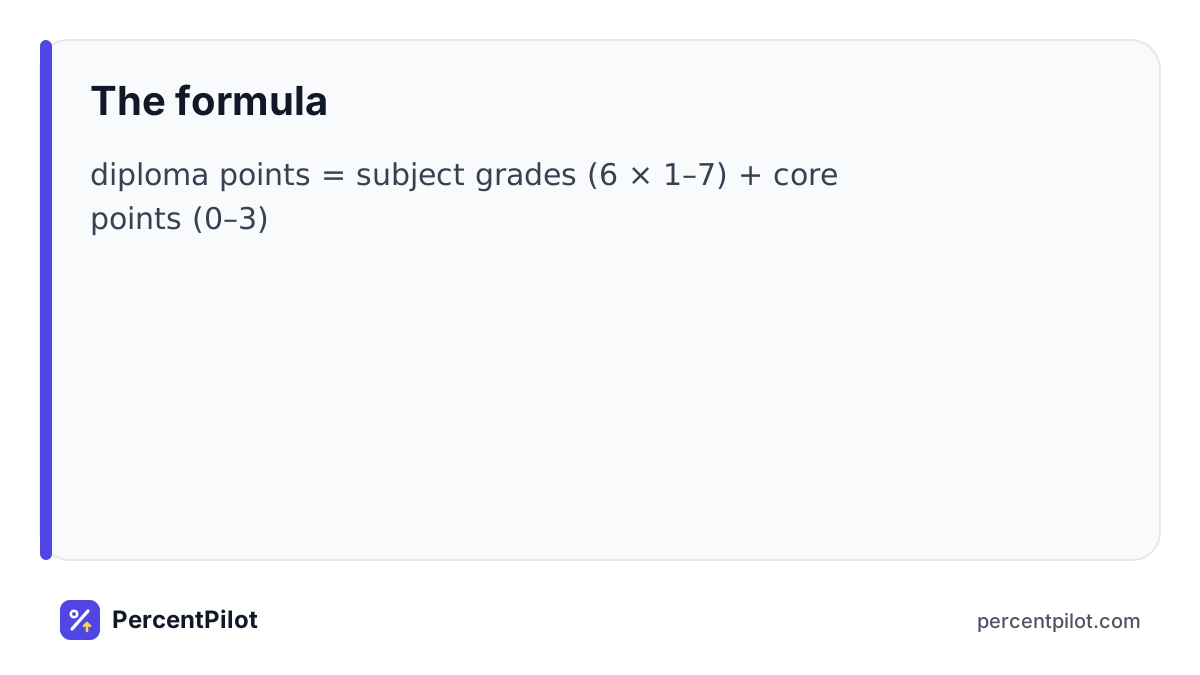
diploma points = subject grades (6 × 1–7) + core points (0–3)
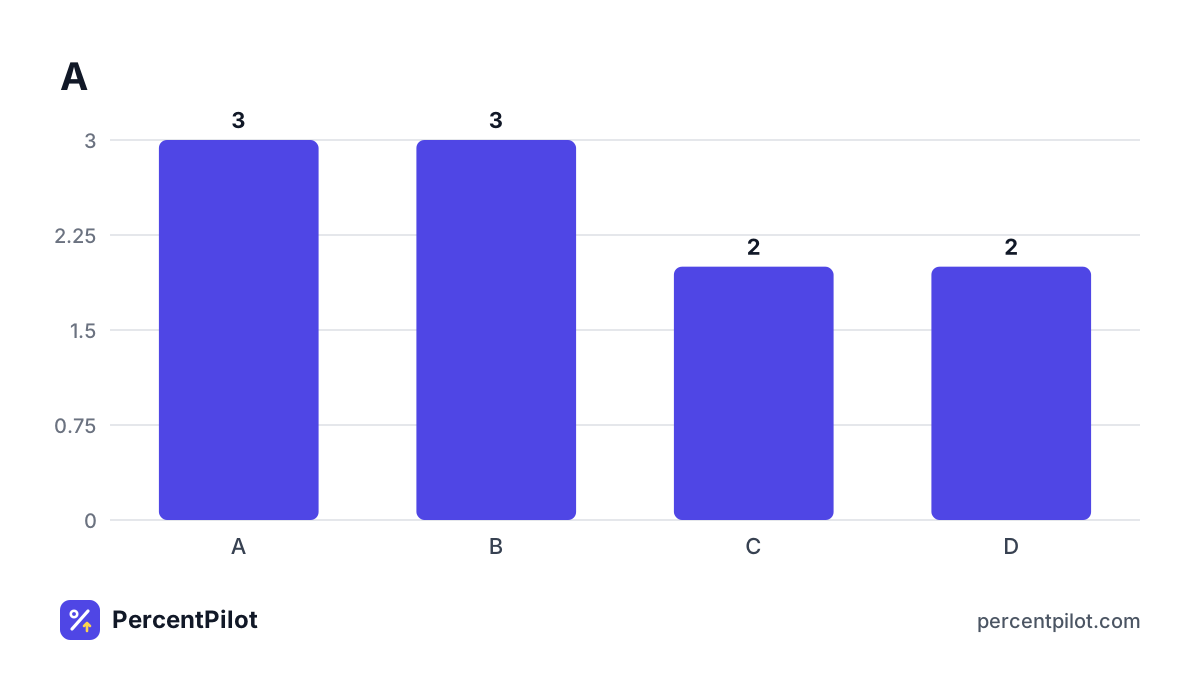
The core points come from this matrix:
| EE \ TOK | A | B | C | D | E |
|---|---|---|---|---|---|
| A | 3 | 3 | 2 | 2 | fail |
| B | 3 | 2 | 2 | 1 | fail |
| C | 2 | 2 | 1 | 0 | fail |
| D | 2 | 1 | 0 | 0 | fail |
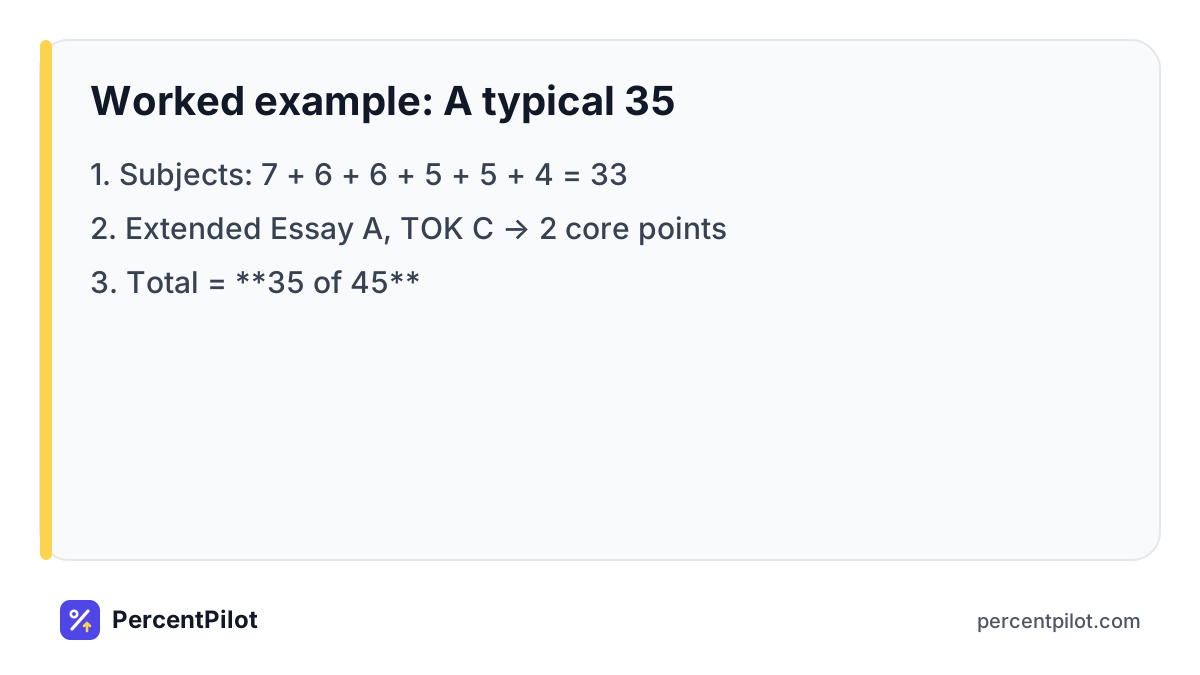
Worked example: A typical 35
- Subjects: 7 + 6 + 6 + 5 + 5 + 4 = 33
- Extended Essay A, TOK C → 2 core points
- Total = 35 of 45
Worked example: 24 points that still fail
- Subjects: 6 + 6 + 5 + 4 + 2 + 1 = 24, core 0 → 24 points
- A grade 1 is a failing condition
- Result: no diploma, even at 24 points
Methodology: how we built this guide
Every figure in this guide comes from the IB: the IBO DP passing criteria (24 points minimum, no grade 1, no E in TOK or the EE, HL and SL minimums) and the IBO assessment brief (PDF) (grade boundaries set after each session). The core-points matrix is the IB’s published matrix. Boundaries themselves are never published in advance — they are set after marking each session, so this guide shows how to use them, not what they will be.
We re-check this page when the IB publishes new regulations. Last updated 21 November 2026.
Expert review pending
No independent IB educator has reviewed this guide yet. We will add their name and credential here when that review is complete.
How one grade changes your total
Take the worked example above: subjects add to 33, and EE A with TOK C gives 2 core points for 35. Now hold the subjects and TOK steady (TOK B) and move only the Extended Essay:
| Extended Essay | TOK | Core points | Total |
|---|---|---|---|
| C | B | 2 | 35 |
| B | B | 2 | 35 |
| A | B | 3 | 36 |
Worked example — improving the Extended Essay from C to B adds nothing to the total when TOK is B; only the step to A adds a point. Check the matrix before you spend weeks on a grade that changes nothing.
The main diploma conditions
- At least 24 points in total.
- CAS completed.
- No grade E in TOK or the Extended Essay, and no N (no grade) anywhere.
- No grade 1 in any subject.
- No more than two grades of 2, and no more than three grades of 3 or below.
- At least 12 points on HL subjects and 9 on SL subjects (for the usual 3 HL + 3 SL).
Accuracy first
Check these conditions against the current IB General Regulations for your session — your IB coordinator has the official version.
How do students usually score?
The IB reports that the average diploma score is around 30 points, and fewer than 1% of candidates reach the full 45.
What NOT to do
- Don’t treat 24 points as a guaranteed pass — the other conditions still apply.
- Don’t assume last session’s boundaries apply to yours.
- Don’t neglect TOK or the EE: an E in either one fails the diploma.
Also useful: how AP exams are scored, how to calculate GPA, and all AP & IB calculators.
Confusion, cleared
Grade calculator vs grade boundaries
They are different steps. Grade boundaries turn your marks into grades (1–7) after each session; the calculator then adds those grades into a diploma total. A calculator cannot tell you your grade from raw marks — only the session’s boundaries can.
24 points vs a pass
24 points is the minimum total, not a pass. A student with 25 points and an E in TOK fails, while a student with 24 points and clean conditions passes. Check the conditions list before the total.
IB grades vs AP scores vs A-levels
The scales do not convert: IB grades run 1–7, AP scores run 1–5, and UK A-levels run A*–E. Universities publish their own IB requirements — see the IB’s university admission pages for how institutions use the diploma. If your school uses a different scale, check with your IB coordinator.
Common mistakes, and what to do instead
The most expensive mistake is treating 24 points as a pass. The second is using last session’s boundaries for yours — they are set fresh after each session. The third is neglecting TOK or the Extended Essay: an E in either one fails the diploma, however strong the subjects are.
Fix the biggest leak first: for most students it is the core. One grade on the Extended Essay or TOK can be worth a full point — or nothing, as the matrix above shows — so check which step actually moves your total before you spend weeks on it.
Who should use this guide, and its limits
Who should use it
IB Diploma students checking predicted grades against a university offer, parents reading a results slip, and teachers explaining the diploma conditions.
Where it falls short
Three honest limits. Grade boundaries are set after each session and never published in advance, so no guide can tell you the exact marks for a 7. Predicted grades come from your teachers, not from the IB. And we have not verified this against every school’s IB handbook: your IB coordinator has the official version for your session. Always confirm a borderline result with your coordinator.
Where you’ll use this
Universities often give conditional offers like “36 points with 6, 6, 5 at Higher Level”. To check whether your predicted grades meet an offer, add the six subjects, add the core points from your TOK and Extended Essay grades, and then check the HL condition separately — the total alone is not enough.
Predicted grades come from your teachers, and final grades come from that session’s grade boundaries. If you are one point short of an offer, the core is often the fastest place to gain: with a B in TOK, moving the Extended Essay from C to A raises core points from 2 to 3. Run your own combinations in the calculator to see which grade matters most for you.
Practice problems (with answers)
Try each one, then check it with the IB Diploma Points Calculator. More tools: all AP & IB score calculators.
- Subjects 7, 7, 6, 6, 6, 5; Extended Essay B, TOK B. What is the total? Answer: 7 + 7 + 6 + 6 + 6 + 5 = 37; core points = 2 → 39 points, which meets the points conditions.
- Subjects 5, 5, 5, 4, 4, 4; Extended Essay C, TOK D. What is the total? Answer: 5 + 5 + 5 + 4 + 4 + 4 = 27; core points = 0 → 27 points, which meets the points conditions.
- Subjects 6, 5, 5, 4, 3, 2; Extended Essay D, TOK E. What is the total? Answer: 6 + 5 + 5 + 4 + 3 + 2 = 25; core points = fail → 25 points, which does not pass: an E in TOK/EE fails the diploma.
Frequently asked questions
What percentage is a 7 in IB?
There is no fixed percentage. The mark needed for a 7 depends on that subject’s grade boundaries for your exam session.
What is the maximum IB score?
45 points: 42 from six subjects plus 3 core points from TOK and the Extended Essay.
Can you pass the IB Diploma with 24 points?
Only if you also meet every other condition, such as CAS, no grade 1 and no E in TOK or the EE.
What is a good IB score?
Around 30 is average; scores in the high 30s and 40s are strong for selective universities.
What IB score do I need for university?
It depends on the university: many ask for 30–36 points, selective ones 38–42, often with specific Higher Level grades. Check the offer, not just the total.
Does the IB grade calculator work for predicted grades?
Yes. Enter your teachers’ predicted grades and your TOK and EE grades; the total shows whether the offer’s points condition is met — but check the Higher Level condition separately.
How do I use the IB grade calculator?
Enter your six subject grades (1–7 each) and your TOK and Extended Essay grades. The calculator adds the subjects, adds the core points from the matrix, and shows your total out of 45.
Conclusion
The IB grade calculator is simple once the parts are clear: six subject grades add to at most 42, TOK and the Extended Essay add up to 3 core points, and 45 is the maximum. But 24 points is a minimum, not a pass — the diploma conditions decide. Check your grades against the matrix and the conditions list, confirm the boundaries for your session with your IB coordinator, and use the calculator to see which single grade moves your total.
Try it now
Put your own grades into the IB Diploma Points Calculator — six subjects plus TOK and EE — and see your total out of 45 in seconds. PercentPilot is free, no signup, no login.
Sources
Spotted an error? Tell us and we will fix it and note the change here.