
An APUSH grade calculator turns four parts — MCQ, SAQ, DBQ and LEQ — into a 1–5. The May 2027 rules changed two of them, so this guide starts with the new weights.
Quick answer
Your APUSH score adds four parts: multiple choice (40%), three short-answer questions (20%), the DBQ (25%) and the long essay (15%). Together they make a composite out of 100. For May 2027 you must answer all three SAQs and one LEQ prompt. On our estimate, about 44 is a 3, 60 a 4 and 78 a 5.
Key takeaways
- MCQ 40%, SAQ 20%, DBQ 25%, LEQ 15% — essays and short answers are 60% together.
- New for May 2027: all three SAQs are required and include a source; the LEQ is one required prompt.
- Each DBQ rubric point is worth about 3.6 composite points — more than 5 multiple-choice questions.
- In 2026, 74% of APUSH students scored 3 or higher.
On this page
- How the APUSH grade calculator works
- The APUSH exam format for May 2027
- How the composite is built
- Estimated cut-offs
- 2026 results
- How to raise your APUSH score fastest
- Where you’ll use this
- Common confusions, cleared up
- Practice problems (with answers)
- How we calculated this
- Conclusion: your APUSH grade calculator, in one line
- Frequently asked questions
- Sources
An APUSH grade calculator is only as good as the weights behind it. This guide gives you the official section weights, the new 2027 question rules, and a simple way to estimate your score by hand.
APUSH Score CalculatorEnter MCQ, SAQ, DBQ and LEQ points for an instant estimate.Open →In this guide
How the APUSH grade calculator works
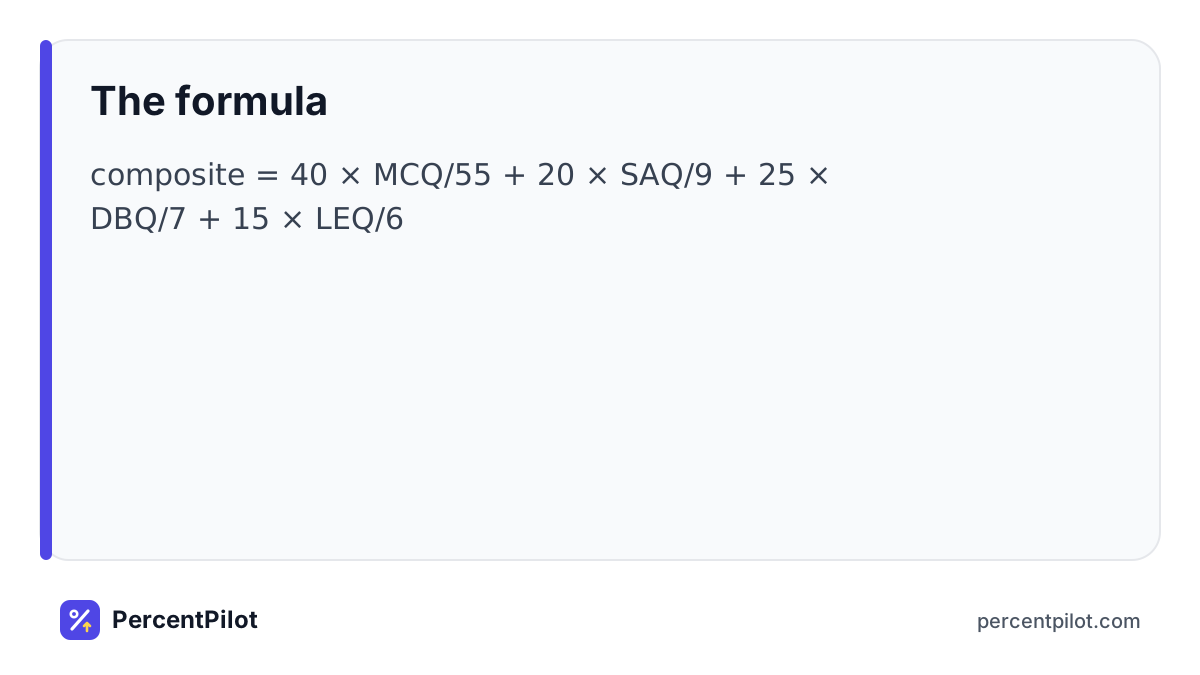
Enter four numbers: MCQ correct out of 55, SAQ points out of 9, DBQ points out of 7 and LEQ points out of 6. Each part becomes its share of the composite — 40, 20, 25 and 15 — and the total out of 100 maps to a 1–5.
The APUSH exam format for May 2027
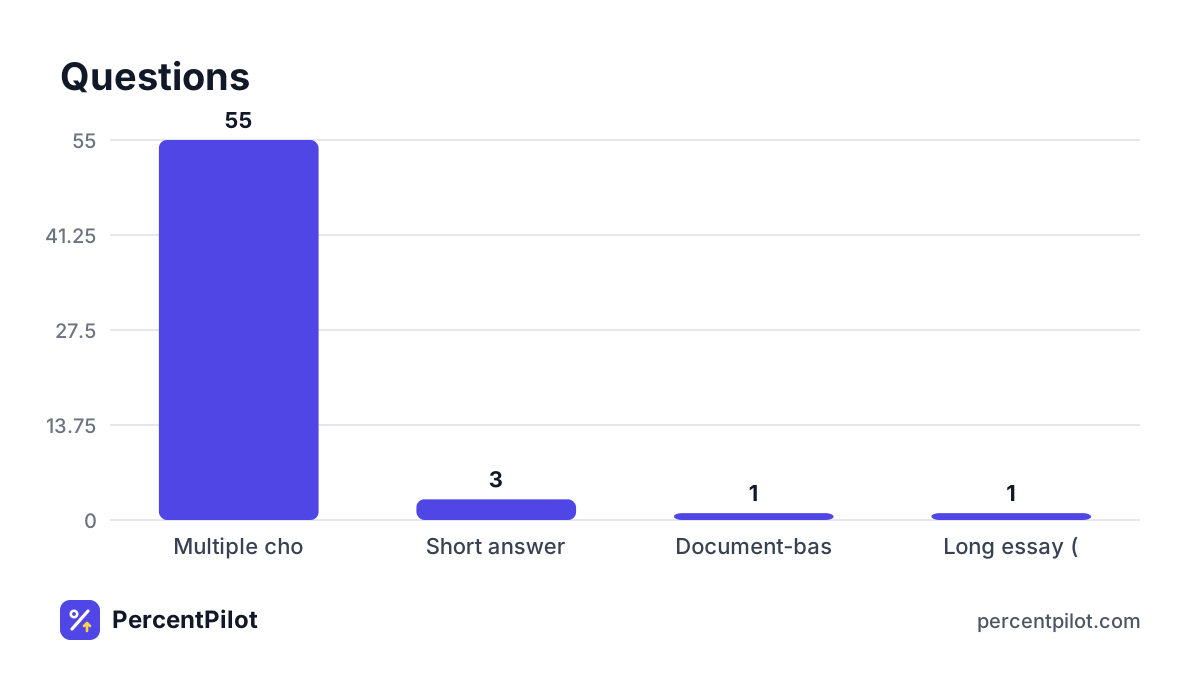
| Part | Questions | Points | Time | Weight |
|---|---|---|---|---|
| Multiple choice | 55 | 55 | 55 min | 40% |
| Short answer (SAQ) | 3 required | 9 | 40 min | 20% |
| Document-based (DBQ) | 1 | 7 | 60 min | 25% |
| Long essay (LEQ) | 1 required | 6 | 40 min | 15% |
How the composite is built
composite = 40 × MCQ/55 + 20 × SAQ/9 + 25 × DBQ/7 + 15 × LEQ/6
Worked example: Strong 4
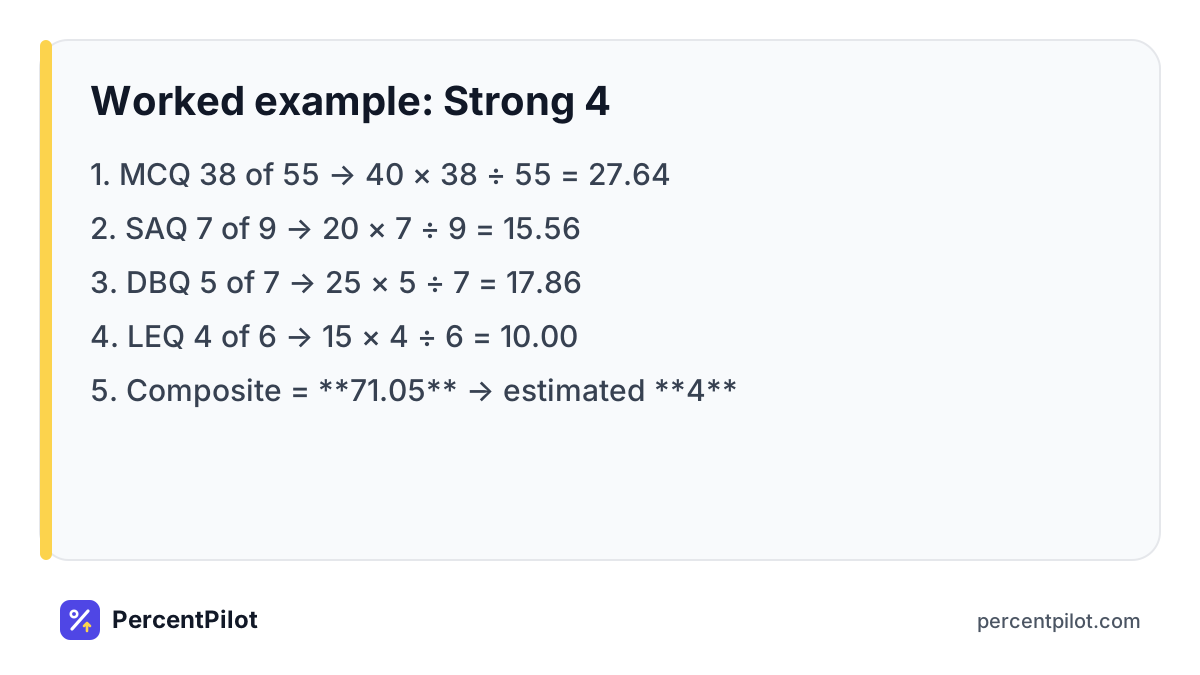
- MCQ 38 of 55 → 40 × 38 ÷ 55 = 27.64
- SAQ 7 of 9 → 20 × 7 ÷ 9 = 15.56
- DBQ 5 of 7 → 25 × 5 ÷ 7 = 17.86
- LEQ 4 of 6 → 15 × 4 ÷ 6 = 10.00
- Composite = 71.05 → estimated 4
Worked example: What a DBQ point is worth
- One DBQ point = 25 ÷ 7 = 3.57 composite points
- One MCQ question = 40 ÷ 55 = 0.73 composite points
- So one extra DBQ point ≈ 5 multiple-choice questions
Worked example: Borderline 3
- MCQ 30 of 55 → 40 × 30 ÷ 55 = 21.82
- SAQ 5 of 9 → 20 × 5 ÷ 9 = 11.11
- DBQ 4 of 7 → 25 × 4 ÷ 7 = 14.29
- LEQ 3 of 6 → 15 × 3 ÷ 6 = 7.50
- Composite = 54.72 → estimated 3
That 54.72 sits in the middle of the estimated 3 band (about 44–59). One more DBQ point (3.57) would take it to 58.29, still a 3; two more would reach 61.86, a 4.
Estimated cut-offs
These are our estimates from public score data, not College Board’s official table.
- 5: about 78+
- 4: about 60–77
- 3: about 44–59
- 2: about 28–43
- 1: below about 28
Accuracy first
The SAQ and LEQ changes are new for 2027, so the curve could move. Check your estimate with the Strict setting and give yourself a few points of margin.
2026 results
In 2026, 14% of APUSH students scored a 5, 37% a 4, 23% a 3, 18% a 2 and 8% a 1 — 74% scored 3 or higher.
How to raise your APUSH score fastest
- Lock in the DBQ basics. Thesis, contextualization and using at least four documents are the most reliable points on the 7-point rubric.
- Write complete SAQ answers. Each part is worth 1 point; answer exactly what the verb asks and add one specific piece of evidence.
- Practice sourcing. Every SAQ now includes a source, so quick sourcing skills pay off twice.
What NOT to do
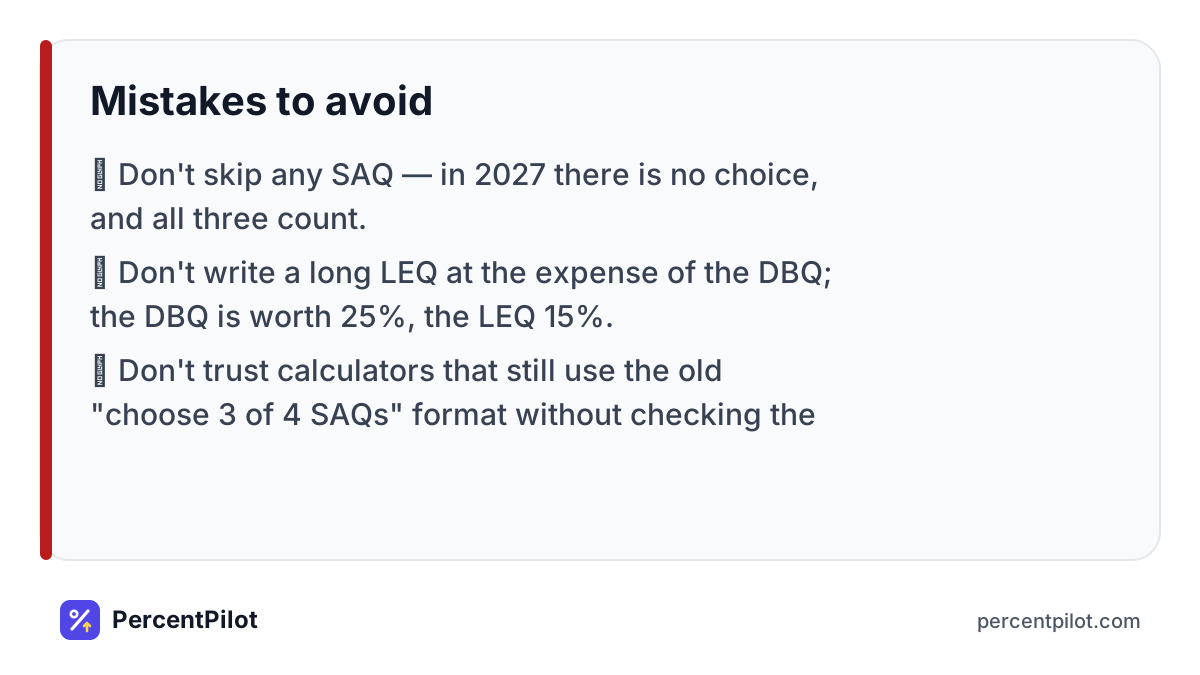
- Don’t skip any SAQ — in 2027 there is no choice, and all three count.
- Don’t write a long LEQ at the expense of the DBQ; the DBQ is worth 25%, the LEQ 15%.
- Don’t trust calculators that still use the old “choose 3 of 4 SAQs” format without checking the 2027 rules.
Next: compare with the AP Lang score guide, read how AP exams are scored, or see all AP calculators.
Where you’ll use this
Say your mock exam comes back with 34 of 55 multiple choice, 6 of 9 on the SAQs, 4 of 7 on the DBQ and 3 of 6 on the LEQ. That works out to 24.73 + 13.33 + 14.29 + 7.50 = 59.85 — right on the edge between a 3 and a 4 in our estimate.
Where should you look first? The DBQ. Each DBQ point is worth 3.57 composite points, so moving from 4 to 6 adds 7.14 and lifts you clearly into the 4 range. Contextualization and sourcing at least two documents are the points students most often leave on the table. Because all three SAQs are now required and each includes a source, practicing quick source analysis helps on both parts at once.
Common confusions, cleared up
APUSH score vs class grade
Your AP score (1–5) is not your class grade: your teacher sets the class grade, College Board sets the AP score. Colleges use it for credit — usually 4 or 5 minimum.
Composite vs raw score
Your raw total is out of 77 points (55 + 9 + 7 + 6). Your composite is the weighted total out of 100. Only the composite maps to a 1–5 — and 55 means 55 out of 100, not 55% correct, because DBQ and LEQ points count more.
SAQ choice is gone in 2027
Before 2027 you chose 3 of 4 SAQs. From May 2027 all three are required, and each includes a source. Calculators that still offer a choice are using the old format — do not use them.
Practice problems (with answers)
Try each one, then check it with the APUSH Score Calculator. More tools: all AP & IB score calculators.
- Estimate the score: Multiple choice 45; Short answer (SAQ) 8 (3 + 3 + 2); Document-based question 6; Long essay 5. Answer: Multiple choice: 45/55 × 40 = 32.73 · Short answer (SAQ): 8/9 × 20 = 17.78 · Document-based question: 6/7 × 25 = 21.43 · Long essay: 5/6 × 15 = 12.5 → composite 84.43 → estimated 5.
- Estimate the score: Multiple choice 33; Short answer (SAQ) 6 (2 + 2 + 2); Document-based question 4; Long essay 3. Answer: Multiple choice: 33/55 × 40 = 24 · Short answer (SAQ): 6/9 × 20 = 13.33 · Document-based question: 4/7 × 25 = 14.29 · Long essay: 3/6 × 15 = 7.5 → composite 59.12 → estimated 3.
- Estimate the score: Multiple choice 25; Short answer (SAQ) 4 (2 + 1 + 1); Document-based question 3; Long essay 2. Answer: Multiple choice: 25/55 × 40 = 18.18 · Short answer (SAQ): 4/9 × 20 = 8.89 · Document-based question: 3/7 × 25 = 10.71 · Long essay: 2/6 × 15 = 5 → composite 42.78 → estimated 2.
How we calculated this
Section weights and the 2027 rules come from College Board, AP United States History Course and Exam Description (2025–26) and the AP history exam updates page. Cut-offs are our estimates from public score distributions — the 2026 distribution (74% scored 3 or higher) is from College Board’s AP United States History score distributions, 2026. Expert review pending — this guide was prepared by the PercentPilot Editorial Team; an educator review is pending. Reviewed by the PercentPilot Editorial Team, 21 November 2026. Updated: 21 November 2026.
Conclusion: your APUSH grade calculator, in one line
An APUSH grade calculator weights four parts — MCQ 40%, SAQ 20%, DBQ 25%, LEQ 15% — into a composite out of 100, and College Board turns that into a 1–5. On our estimate, 44 is a 3, 60 is a 4 and 78 is a 5. Treat the lines as estimates, answer all three SAQs, and spend your remaining time on the DBQ.
Frequently asked questions
How is the APUSH exam scored?
Each part is converted to its weight (40/20/25/15) and added into a composite out of 100. College Board then converts the composite into a 1–5 score.
How many points is the DBQ?
The DBQ is scored on a 7-point rubric and is worth 25% of the APUSH score.
Do you have to answer all three SAQs in 2027?
Yes. Starting in May 2027, all three short-answer questions are required.
What composite score is a 5 on APUSH?
On our estimate, about 78 out of 100 in an average year. The official line changes from year to year.
How do I use the APUSH grade calculator?
Enter your MCQ correct out of 55, SAQ points out of 9, DBQ points out of 7 and LEQ points out of 6. You get a composite out of 100 and an estimated 1–5 — check the Strict setting too, and plan for that number.
What changed for the APUSH exam in 2027?
All three SAQs are now required and include a source, and the LEQ is one required prompt. The section weights (40/20/25/15) did not change.
Is the DBQ really worth more than the LEQ?
Yes. The DBQ is 25% of your score and the LEQ 15%. One DBQ rubric point is worth about 3.57 composite points; one LEQ point is worth 2.5.
Try the APUSH Score Calculator
Enter your MCQ, SAQ, DBQ and LEQ points for an instant estimate under the May 2027 rules. Free — no sign-up, no email, nothing stored.
Sources
Spotted an error? Tell us and we will fix it and note the change here.