
Quick answer
To calculate GPA, turn each letter grade into grade points (A = 4.0, B = 3.0, C = 2.0, D = 1.0, F = 0), multiply each by the class’s credits, add those quality points, and divide by your total credits. Five 1-credit classes with A, B+, A−, B and A give 18.0 ÷ 5 = a 3.60 GPA.
On this page
How to calculate GPA in four steps, with worked examples.
- Step 1: Turn letter grades into grade points
- Step 2: Multiply by credits
- Step 3 and 4: Add and divide
- Weighted vs. unweighted GPA
- How to calculate GPA over a full year
- GPA vs percentage: clearing up the confusion
- Methodology
- Limitations: what this guide can’t tell you
- Conclusion: how to calculate GPA in four steps
- Frequently asked questions
Key takeaways
- GPA = total quality points ÷ total credits.
- Quality points = grade points × credits.
- Weighted GPA adds bonus points for Honors and AP/IB classes.
- Your school’s handbook decides the exact scale.
On this page
- Step 1: Turn letter grades into grade points
- Step 2: Multiply by credits
- Step 3 and 4: Add and divide
- Weighted vs. unweighted GPA
- How to calculate GPA over a full year
- Where you’ll use this
- Practice problems (with answers)
- GPA vs percentage: clearing up the confusion
- Methodology
- Limitations: what this guide can’t tell you
- Conclusion: how to calculate GPA in four steps
- Frequently asked questions
- Sources
Knowing how to calculate GPA lets you check your report card, plan next semester and see how one grade changes the total. You only need your letter grades, the credits for each class and a 4.0 scale.
GPA CalculatorWeighted and unweighted GPA with Honors and AP.Open →Step 1: Turn letter grades into grade points
| Letter | Grade points | Letter | Grade points |
|---|---|---|---|
| A / A+ | 4.0 | C+ | 2.3 |
| A− | 3.7 | C | 2.0 |
| B+ | 3.3 | C− | 1.7 |
| B | 3.0 | D+ | 1.3 |
| B− | 2.7 | D | 1.0 |
| F | 0.0 | D− | 0.7 |
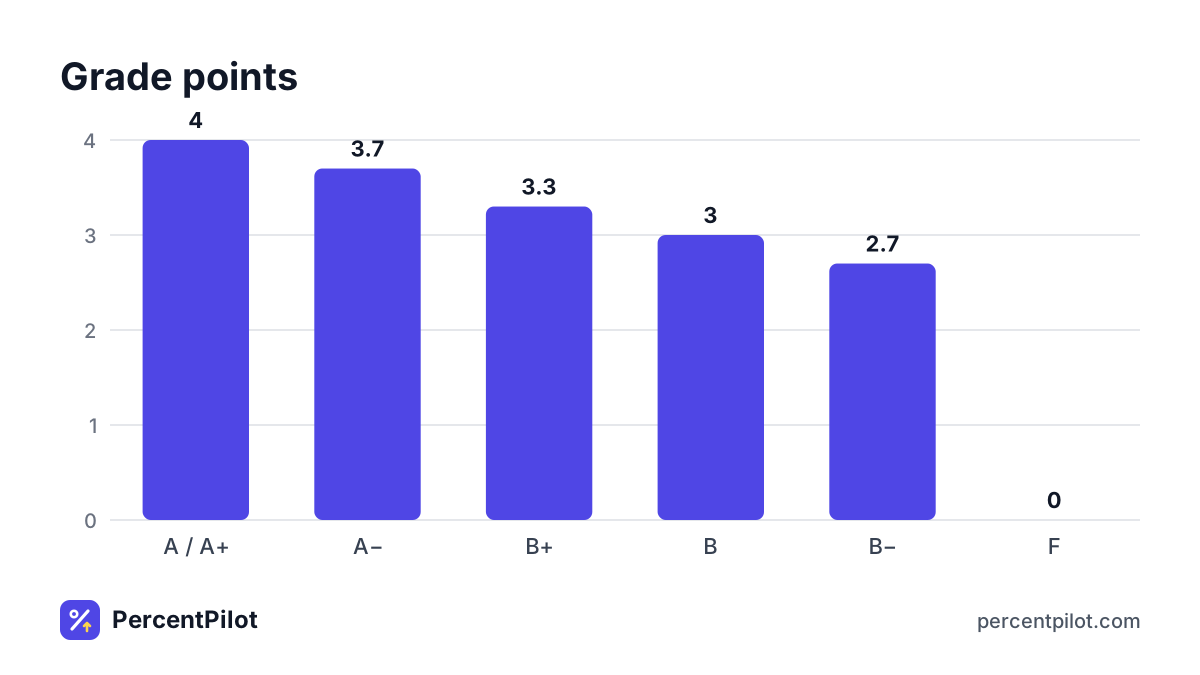
This is the most common US 4.0 scale. Some schools count A+ as 4.3 or skip plus and minus grades.
Step 2: Multiply by credits
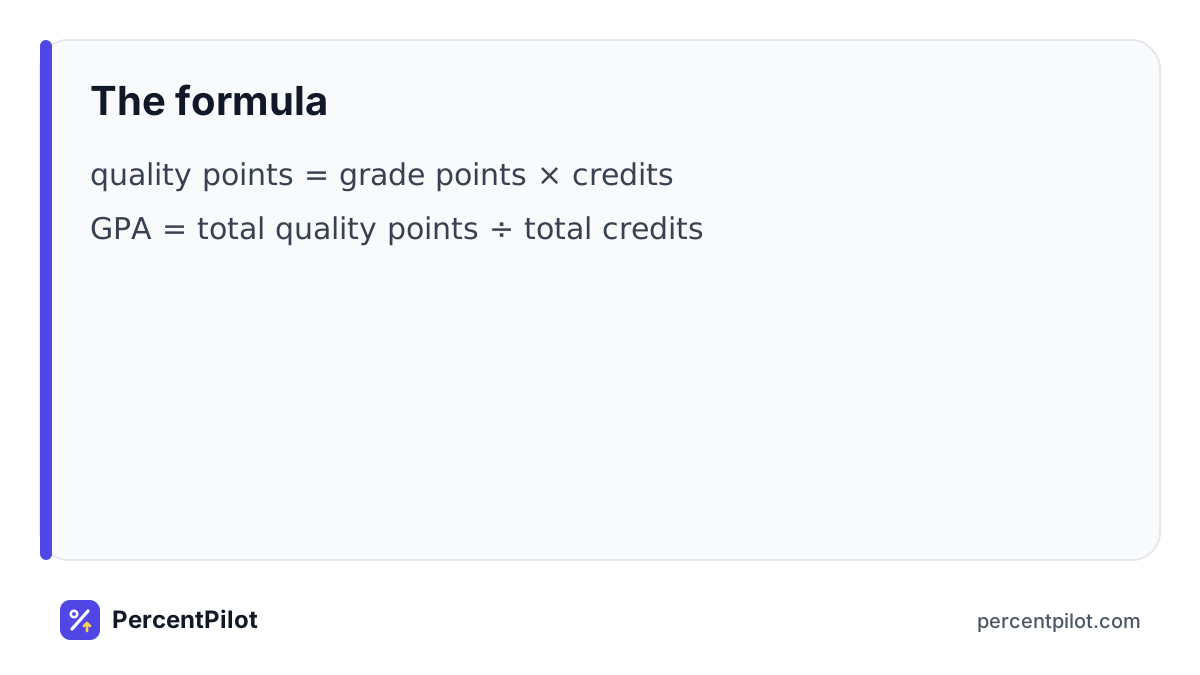
quality points = grade points × credits
GPA = total quality points ÷ total credits
Step 3 and 4: Add and divide
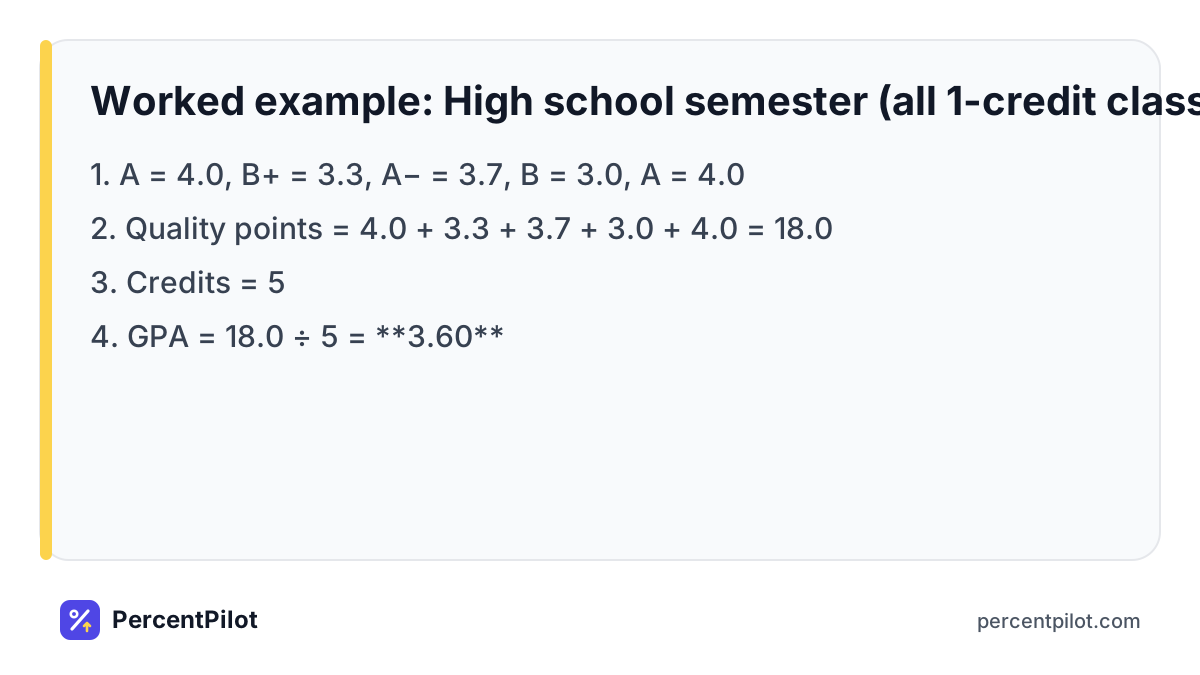
Worked example: High school semester (all 1-credit classes)
- A = 4.0, B+ = 3.3, A− = 3.7, B = 3.0, A = 4.0
- Quality points = 4.0 + 3.3 + 3.7 + 3.0 + 4.0 = 18.0
- Credits = 5
- GPA = 18.0 ÷ 5 = 3.60
Worked example: College semester (different credits)
- Biology A, 4 credits → 4.0 × 4 = 16.0
- Calculus B, 3 credits → 3.0 × 3 = 9.0
- History C, 3 credits → 2.0 × 3 = 6.0
- Seminar A−, 2 credits → 3.7 × 2 = 7.4
- GPA = 38.4 ÷ 12 credits = 3.20
Notice that the 4-credit A pulls the GPA up more than the 2-credit A− — credits act as weights.
Weighted vs. unweighted GPA
An unweighted GPA uses the plain 4.0 scale. A weighted GPA adds a bonus for harder classes — often +0.5 for Honors and +1.0 for AP or IB. In the first example, if English were Honors and one class AP, the weighted GPA would be (4.5 + 3.3 + 4.7 + 3.0 + 4.0) ÷ 5 = 3.90.
Learn more in how to calculate weighted GPA.
How to calculate GPA over a full year
A full-year GPA is not the average of two semester GPAs — it is one calculation over every class in the year, with credits as weights. Here: 5 credits in the fall, 6 in the spring.
| Term | Quality points | Credits | Term GPA |
|---|---|---|---|
| Fall | 16.5 | 5 | 3.30 |
| Spring | 22.2 | 6 | 3.70 |
| Full year | 38.7 | 11 | 3.52 |
Full-year GPA = 38.7 ÷ 11 = 3.52. The plain average of the two term GPAs (3.30 + 3.70) ÷ 2 = 3.50, which is wrong, because spring carries more credits. A GPA is a weighted mean: each grade counts in proportion to its credits. Maths is Fun explains the weighted mean the same way.
Accuracy first
Check your answer: your GPA must sit between your lowest and highest grade points. If you got 3.0 and 4.0 grades and your GPA is 2.8, a credit or grade was typed wrong.
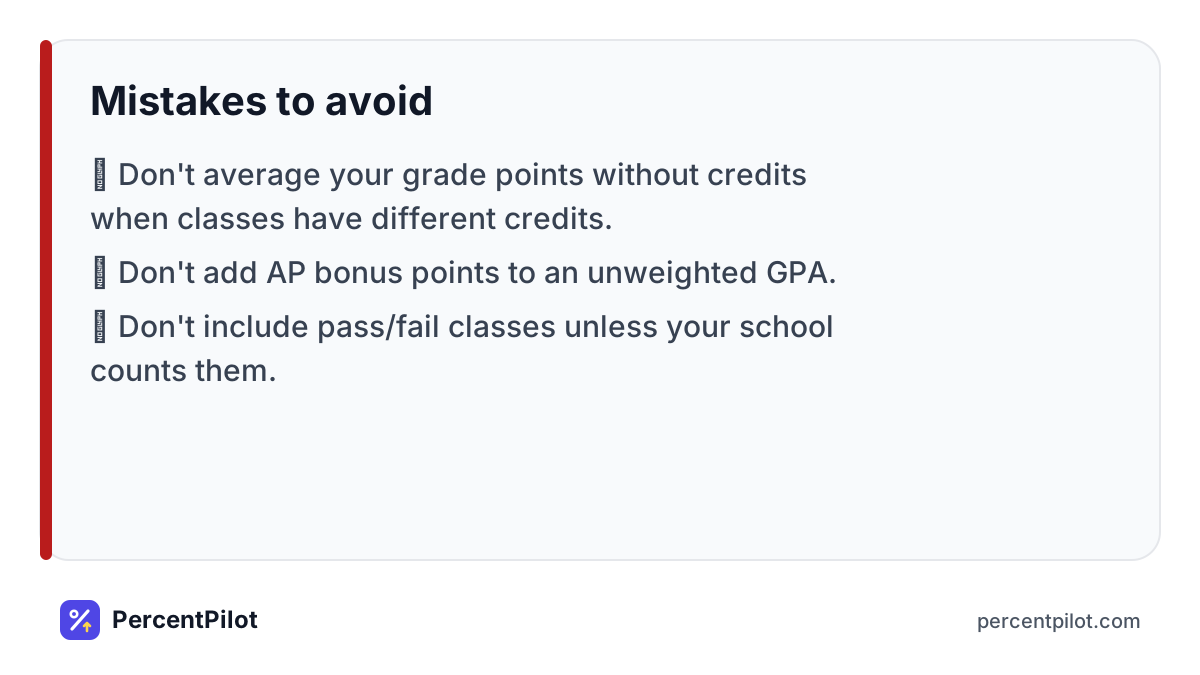
What NOT to do
- Don’t average your grade points without credits when classes have different credits.
- Don’t add AP bonus points to an unweighted GPA.
- Don’t include pass/fail classes unless your school counts them.
Next steps: high school GPA, cumulative GPA, GPA in Excel, and every GPA calculator.
Where you’ll use this
Report cards, scholarship forms and college applications all ask for your GPA, but they don’t always mean the same thing. A scholarship might ask for an unweighted GPA on a 4.0 scale, while your school’s report card shows a weighted one. Knowing how to calculate both means you can give the right number without waiting for your counselor.
GPA math also helps with planning. Before you drop a class or pick an elective, you can see how a B instead of an A would change your GPA. With five 1-credit classes, each letter step in one class (say A to A−) moves your GPA by 0.06. With twelve classes on your transcript, the same step moves it by only 0.025.
Practice problems (with answers)
Try each one, then check it with the GPA Calculator. More tools: all GPA calculators.
- Find the GPA: A (1 cr), A (1 cr), B (1 cr), B (1 cr), C (1 cr). Answer: Quality points: 4.0 × 1 + 4.0 × 1 + 3.0 × 1 + 3.0 × 1 + 2.0 × 1 = 16.00; credits 5 → GPA = 3.20.
- Find the GPA: A− (3 cr), B+ (4 cr), B (3 cr), A (2 cr). Answer: Quality points: 3.7 × 3 + 3.3 × 4 + 3.0 × 3 + 4.0 × 2 = 41.30; credits 12 → GPA = 3.44.
- Find the GPA: B− (1 cr), C+ (1 cr), A (1 cr), B+ (0.5 cr). Answer: Quality points: 2.7 × 1 + 2.3 × 1 + 4.0 × 1 + 3.3 × 0.5 = 10.65; credits 3.5 → GPA = 3.04.
GPA vs percentage: clearing up the confusion
A GPA and a percentage measure different things. A percentage says how much of the available marks you earned in one class. A GPA turns each class grade into points and averages them with credits as weights. You cannot turn a percentage straight into a GPA without your school’s grade scale — 91% is usually an A− (3.7), but some schools call it an A (4.0).
The same confusion shows up with “grade” and “mark”. In the US, a “grade” usually means the letter (A, B); in the UK, “mark” is the usual word for the score, and “maths” is the subject where the US says “math”. Either way the maths is the same: convert to points first, then weight by credits. And a GPA is not a percent — a 3.5 GPA is not “87.5%”.
Methodology
Every formula here follows the standard US 4.0 scale: A = 4.0, B = 3.0, C = 2.0, D = 1.0, F = 0, with plus and minus grades shifting the value by 0.3 (A− 3.7, B+ 3.3). The scale comes from the common US grading scale documented in Wikipedia’s “Academic grading in the United States” and the National Center for Education Statistics High School Transcript Study, both cited in the sources below. Weighted bonuses of +0.5 for Honors and +1.0 for AP/IB are the most common school rules, not a national rule. Updated: 21 November 2026.
Check your answer three ways. Your GPA must fall between your lowest and highest grade points. A class with more credits must pull the result further toward its grade. And the same grades and credits must give the same GPA in any order.
Limitations: what this guide can’t tell you
This guide covers the standard US 4.0 scale only — not every school’s scale. Some use a 5.0 weighted scale, some give A+ a 4.3, some skip plus and minus grades, and some count only core classes. Check your school’s handbook before you report a GPA anywhere official. We have not verified this method against every school’s scale.
Who should use this method: any student on a US 4.0 scale checking a term or cumulative GPA. Who should not: students on a percentage-only or 10-point system, where the letter-to-point step does not apply. And remember: a GPA is a summary, not a verdict — two students with the same GPA can have very different transcripts.
Expert review
Expert review pending. This guide was prepared by the PercentPilot Editorial Team from the standard US 4.0 scale and the National Center for Education Statistics High School Transcript Study. A named educator review is pending.
Conclusion: how to calculate GPA in four steps
To calculate GPA, convert each grade to points, multiply by credits, add the quality points, and divide by total credits. Check the answer sits between your lowest and highest grade points, and confirm the scale with your school.
Frequently asked questions
How do I calculate my GPA from percentages?
First turn each percentage into a letter grade (for example 91% = A−), then into grade points, then follow the same steps.
What is a 3.5 GPA in letter grades?
A 3.5 is halfway between a B+ (3.3) and an A− (3.7) — mostly A− and B+ grades.
Does an F count in GPA?
Yes. An F is 0 grade points but its credits still count, so it pulls the GPA down.
Is GPA calculated per semester or per year?
Both. Schools report a term GPA and a cumulative GPA that covers every term so far.
How do I calculate GPA with credit hours?
Multiply each class’s grade points by its credit hours, add the results, and divide by the total credit hours. A 4-credit A counts twice as much as a 2-credit A.
How do I calculate GPA for a full year?
Divide the whole year’s quality points by the whole year’s credits. Never average the two semester GPAs.
Sources
Spotted an error? Tell us and we will fix it and note the change here.
PercentPilot is free — no signup, no login, and no courses sold.