
Quick answer
To calculate a weighted GPA, add a bonus to each class’s grade points — commonly +0.5 for Honors and +1.0 for AP or IB — then multiply by credits, add them up and divide by total credits. An A in an AP class becomes 5.0 instead of 4.0, so a weighted GPA can go above 4.0.
Key takeaways
- Weighted points = grade points + level bonus.
- Common bonuses: Honors +0.5, AP/IB/dual enrollment +1.0 (some schools use +0.5).
- Weighted GPA rewards harder classes; unweighted GPA shows grades only.
- Report both when an application asks.
On this page
A weighted GPA shows colleges that you took harder classes. The method is the same as a normal GPA with one extra step: add the bonus before you multiply by credits.
Weighted GPA CalculatorMark each class Regular, Honors or AP/IB.Open →Weighted grade points
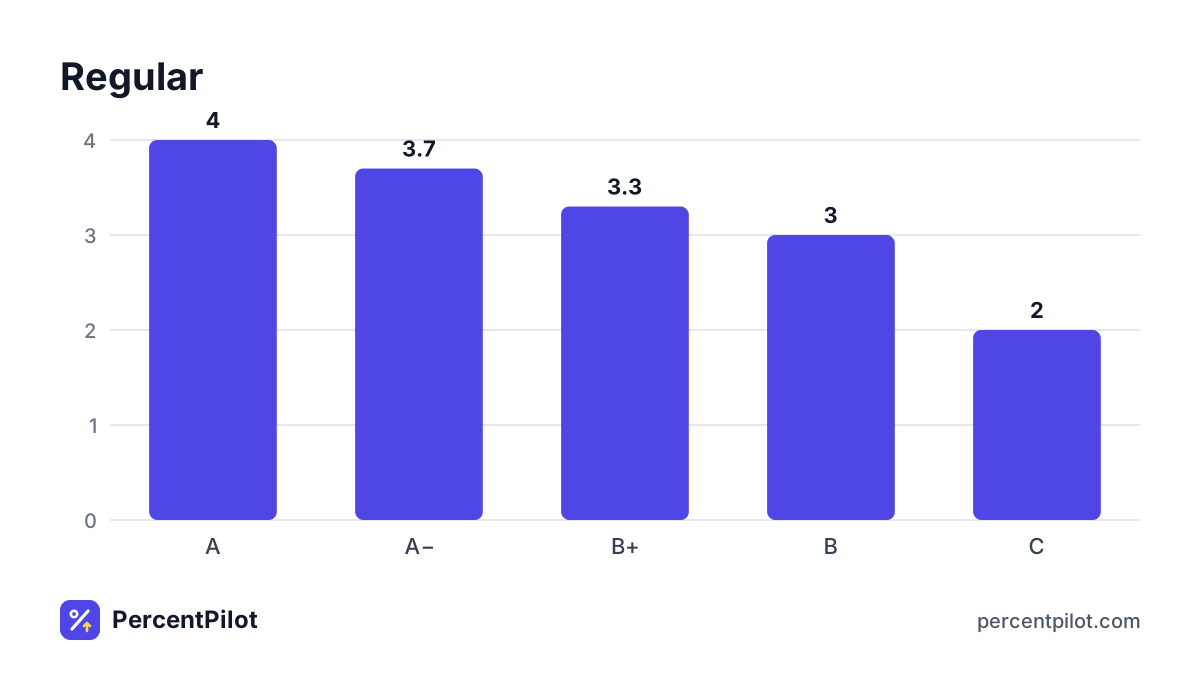
| Grade | Regular | Honors (+0.5) | AP / IB (+1.0) |
|---|---|---|---|
| A | 4.0 | 4.5 | 5.0 |
| A− | 3.7 | 4.2 | 4.7 |
| B+ | 3.3 | 3.8 | 4.3 |
| B | 3.0 | 3.5 | 4.0 |
| C | 2.0 | 2.5 | 3.0 |
The formula
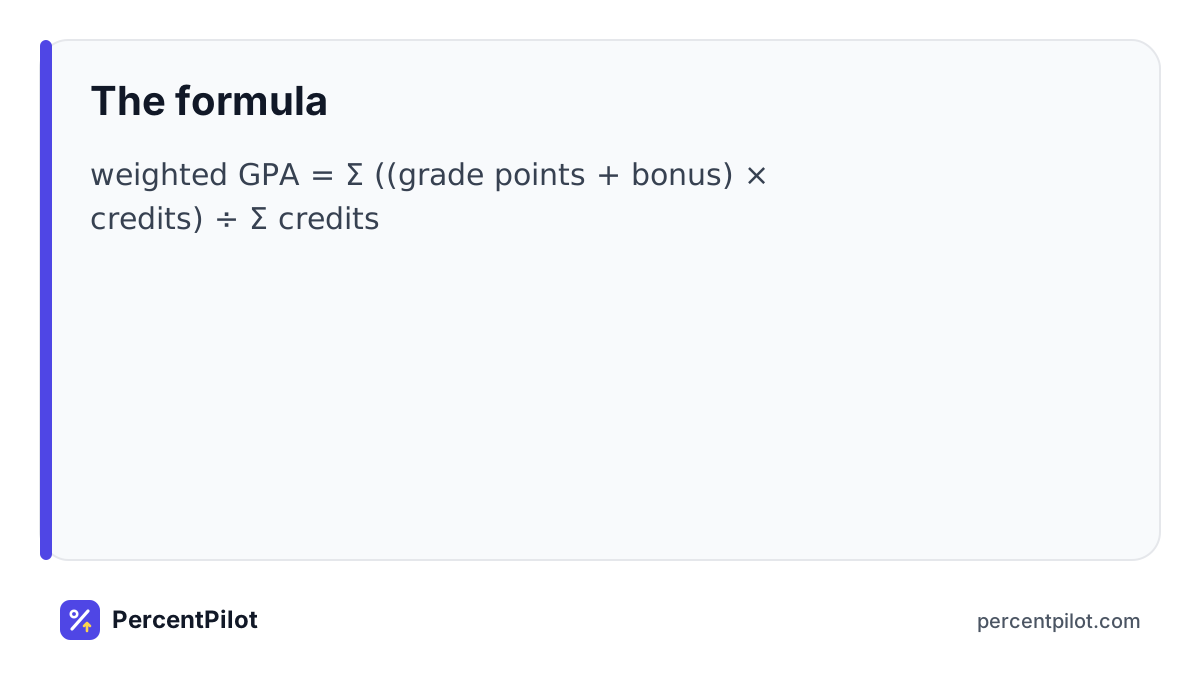
weighted GPA = Σ ((grade points + bonus) × credits) ÷ Σ credits
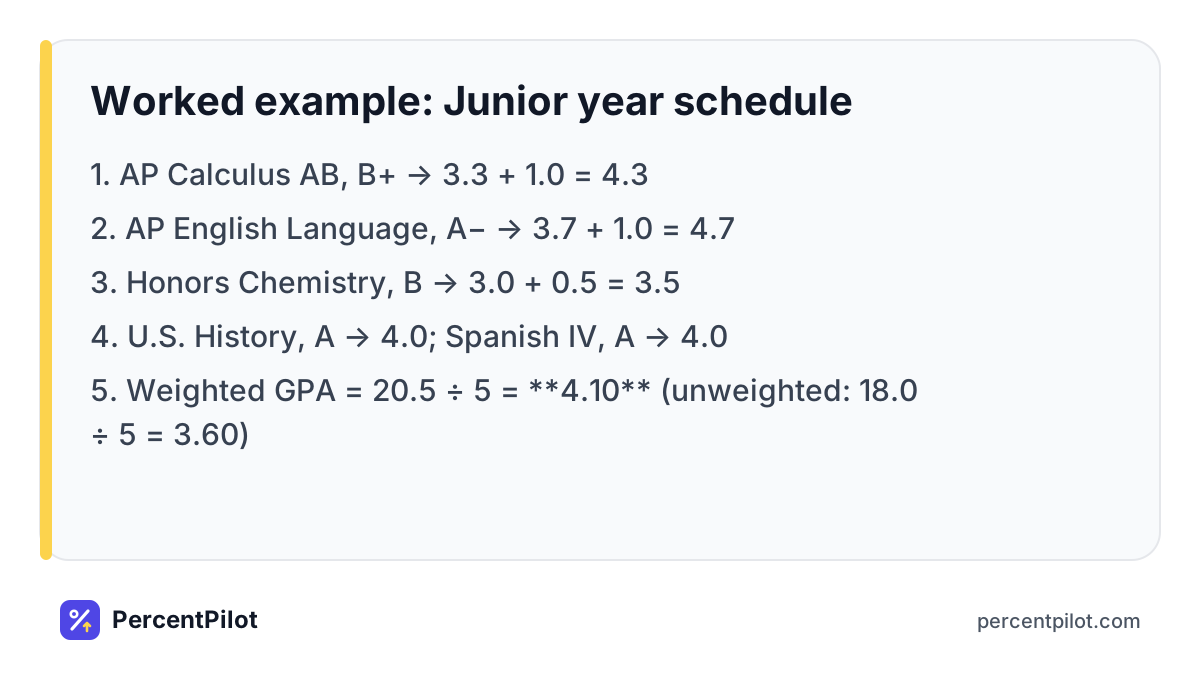
Worked example: Junior year schedule
- AP Calculus AB, B+ → 3.3 + 1.0 = 4.3
- AP English Language, A− → 3.7 + 1.0 = 4.7
- Honors Chemistry, B → 3.0 + 0.5 = 3.5
- U.S. History, A → 4.0; Spanish IV, A → 4.0
- Weighted GPA = 20.5 ÷ 5 = 4.10 (unweighted: 18.0 ÷ 5 = 3.60)
Worked example: Same grades, +0.5 AP scale
- AP classes get +0.5 instead of +1.0 → 3.8 and 4.2
- Sum = 3.8 + 4.2 + 3.5 + 4.0 + 4.0 = 19.5
- Weighted GPA = 19.5 ÷ 5 = 3.90
The scale your school uses changes the number by 0.2 here — always say which scale you mean.
Accuracy first
Check your handbook for three rules: the bonus per level, whether a D or F still gets a bonus, and whether there is a cap (some schools cap weighted GPA at 5.0 or limit the number of weighted classes).
Weighted or unweighted: which matters more?
Colleges see both, plus the classes themselves. Many admissions offices recalculate GPA their own way, so a strong unweighted GPA in challenging classes is the safest goal.
What NOT to do
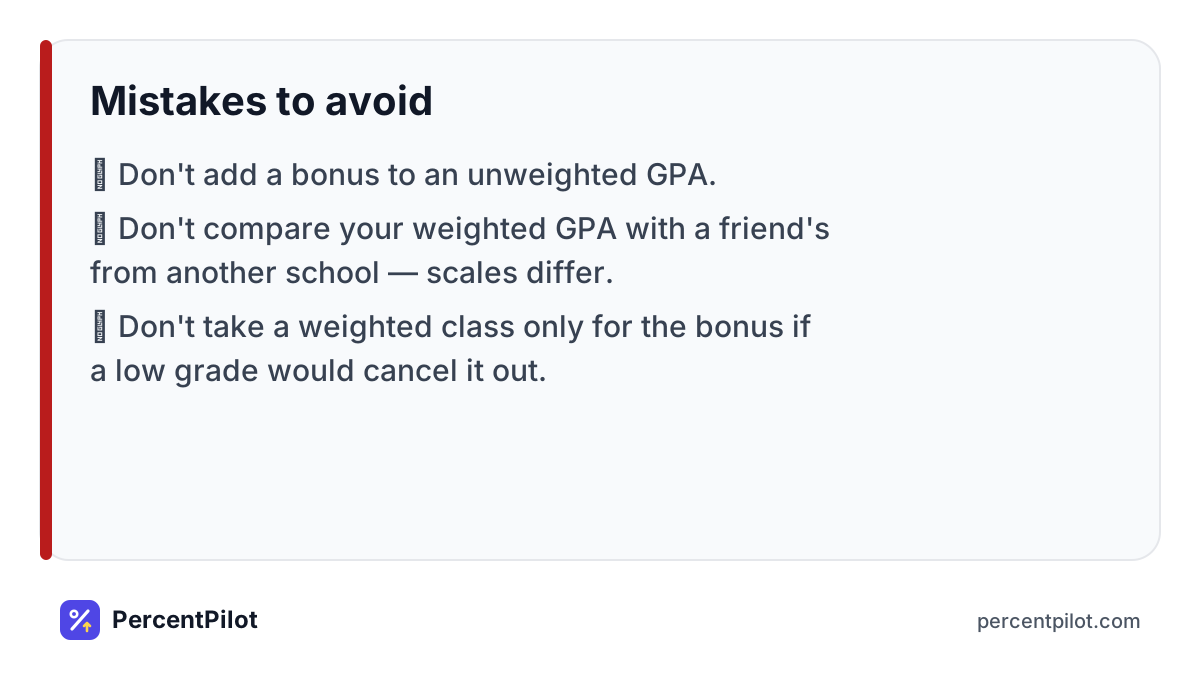
- Don’t add a bonus to an unweighted GPA.
- Don’t compare your weighted GPA with a friend’s from another school — scales differ.
- Don’t take a weighted class only for the bonus if a low grade would cancel it out.
Related: how to calculate GPA, high school GPA, cumulative GPA, all GPA calculators.
Where you’ll use this
Choosing between a regular and an AP class? Weighted GPA helps you compare. On a +1.0 AP scale, a B in AP (4.0) counts the same as an A in a regular class (4.0). On a +0.5 scale, the AP B is worth 3.5 — less than the regular A. Your school’s scale changes the math, so look it up before you decide.
Keep in mind that colleges see the class names on your transcript, not just the weighted number. A strong grade in a challenging class usually helps more than the weighted GPA alone suggests. Many students take the harder class where they can earn at least a B, and the regular class where they might struggle to pass.
Practice problems (with answers)
Try each one, then check it with the Weighted GPA Calculator. More tools: all GPA calculators.
- Find the weighted and unweighted GPA (Honors +0.5, AP +1.0): A (AP), B+ (AP), A− (Honors), A (Regular). Answer: Weighted points: 5.0 + 4.3 + 4.2 + 4.0 = 17.5 → weighted GPA 4.38; unweighted 15.0 ÷ 4 = 3.75.
- Find the weighted and unweighted GPA (Honors +0.5, AP +1.0): B (AP), B (Honors), A (Regular), B+ (Regular). Answer: Weighted points: 4.0 + 3.5 + 4.0 + 3.3 = 14.8 → weighted GPA 3.70; unweighted 13.3 ÷ 4 = 3.33.
- Find the weighted and unweighted GPA (Honors +0.5, AP +1.0): A− (AP), A− (AP), A (AP), B+ (Honors), A (Regular). Answer: Weighted points: 4.7 + 4.7 + 5.0 + 3.8 + 4.0 = 22.2 → weighted GPA 4.44; unweighted 18.7 ÷ 5 = 3.74.
Frequently asked questions
Is a 4.1 weighted GPA good?
Yes, at most schools. It usually means mostly A and B grades with several Honors or AP classes.
Do colleges use weighted GPA?
They see it, but many recalculate. Admissions officers also look at which classes you took.
Does an AP class always add 1.0?
No. Many schools add 1.0, some add 0.5, and some don’t weight at all. Check your school’s policy.
Sources
Spotted an error? Tell us and we will fix it and note the change here.