
Quick answer
Your cumulative GPA is total quality points across every term divided by total credits. Multiply each term’s GPA by its credits, add the results, and divide by all credits. A 3.20 over 60 credits plus a 3.60 over 15 credits gives (192 + 54) ÷ 75 = 3.28.

Key takeaways
- Cumulative GPA = (GPA₁ × credits₁ + GPA₂ × credits₂ + …) ÷ total credits.
- Never average term GPAs without credits.
- The more credits you have, the slower your GPA moves.
- To hit a target, solve for the GPA you need on the new credits.
On this page
Your cumulative GPA is the number colleges, scholarships and honor societies look at first. Here is how to update it after each term and how to plan for a goal.
Cumulative GPA CalculatorAdd a semester or find the GPA you need.Open →The formula
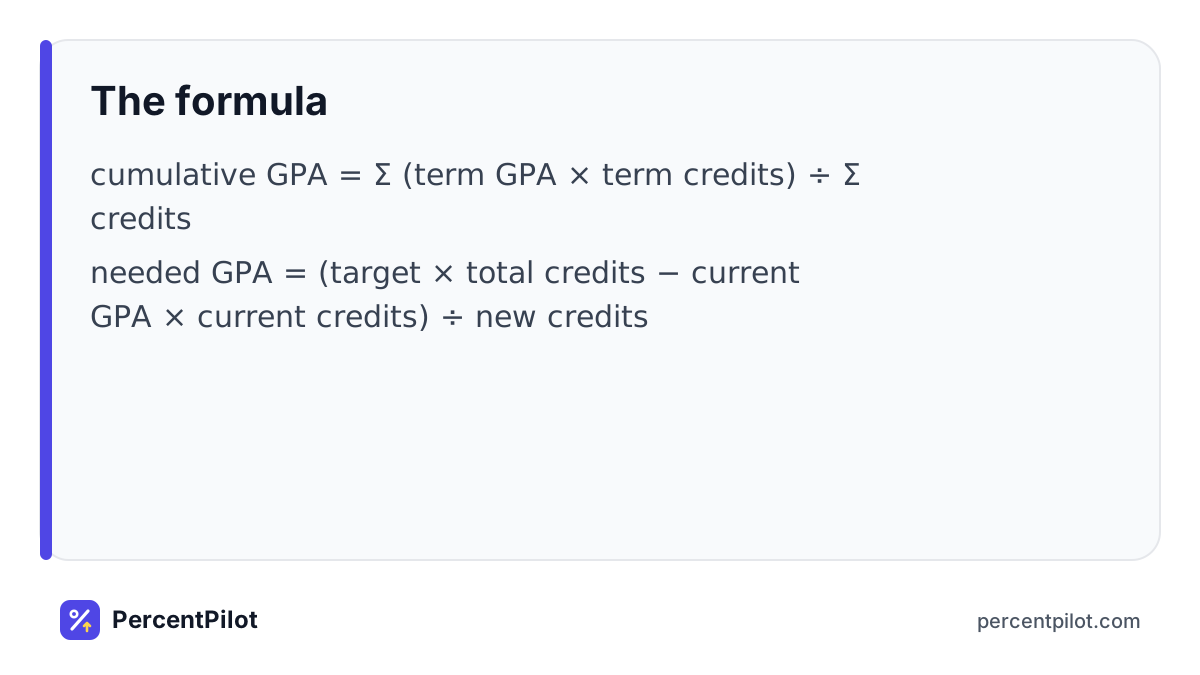
cumulative GPA = Σ (term GPA × term credits) ÷ Σ credits
needed GPA = (target × total credits − current GPA × current credits) ÷ new credits
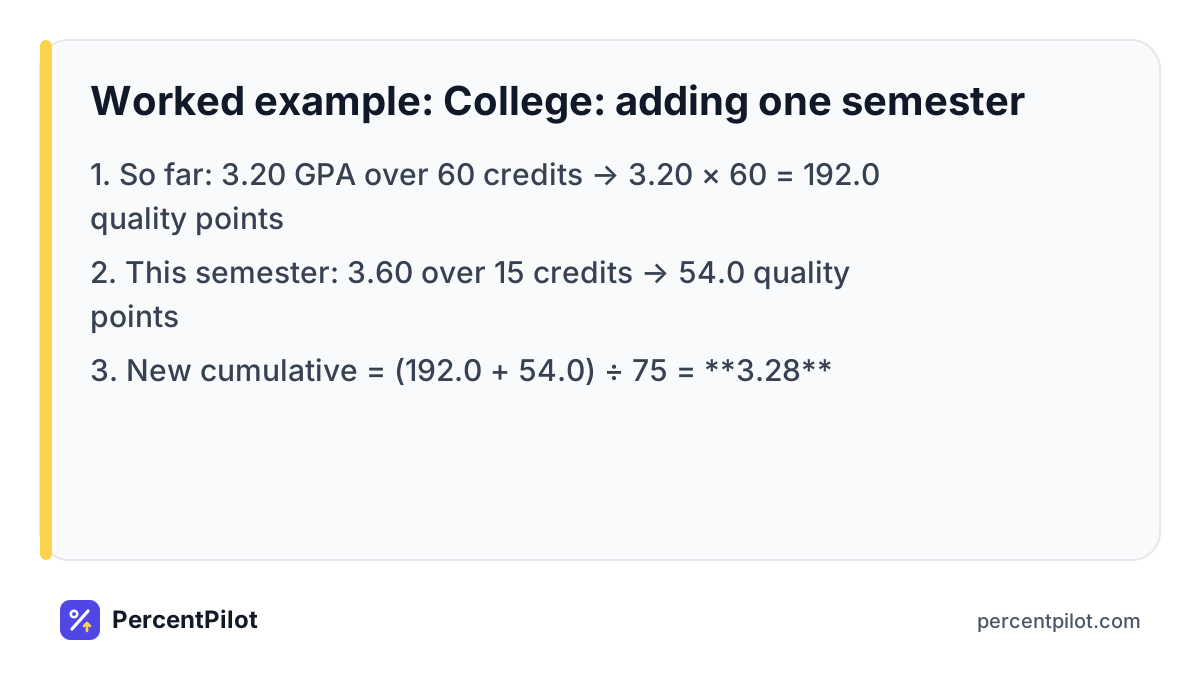
Worked example: College: adding one semester
- So far: 3.20 GPA over 60 credits → 3.20 × 60 = 192.0 quality points
- This semester: 3.60 over 15 credits → 54.0 quality points
- New cumulative = (192.0 + 54.0) ÷ 75 = 3.28
Worked example: High school: adding a semester
- So far: 3.45 over 14 credits → 48.3
- New semester: 3.90 over 7 credits → 27.3
- Cumulative = 75.6 ÷ 21 = 3.60
How long will it take to reach a target?
Start from a 3.20 over 60 credits and aim for a 3.50:
| More credits | GPA you need on them |
|---|---|
| 15 | 4.70 (not possible) |
| 30 | 4.10 (not possible) |
| 60 | 3.80 |
| 90 | 3.70 |

The longer you have, the more realistic the goal becomes. This is why early grades matter so much.
Accuracy first
Check your numbers: the new cumulative GPA must land between your old GPA and the new term’s GPA. 3.28 sits between 3.20 and 3.60, so the math is consistent.
Retakes and transfer credits
Rules differ: some colleges replace the old grade when you retake a class, others average both attempts, and transfer credits often count for credit but not for GPA. Read your registrar’s policy before you plan around a retake.
What NOT to do
- Don’t average term GPAs (3.20 and 3.60 → 3.40) — credits decide the weight.
- Don’t count pass/fail or withdrawn classes unless your school does.
- Don’t assume a retake replaces the old grade; check your school’s policy.

Related: how to calculate GPA, weighted GPA, GPA in Excel, all GPA calculators.
Where you’ll use this
Cumulative GPA matters most when there’s a cut-off: a scholarship that requires a 3.0 to renew, a nursing or engineering program that admits at a 3.3, or academic probation below a 2.0. If you are close to one of those lines, work out exactly what you need before the semester starts rather than after grades post.
The target formula turns a vague goal into a plan. Suppose you have a 2.85 over 45 credits and need a 3.00 to keep a scholarship after the next 15 credits. You need (3.00 × 60 − 2.85 × 45) ÷ 15 = 3.45 that semester. Now you know you need mostly A’s and B’s — and you can talk to your advisor about a lighter load if that isn’t realistic.
Practice problems (with answers)
Try each one, then check it with the Cumulative GPA Calculator. More tools: all GPA calculators.
- Current GPA 3 over 30 credits; this term 3.5 over 15 credits. New cumulative GPA? Answer: (3.00 × 30 + 3.50 × 15) ÷ 45 = 142.5 ÷ 45 = 3.17.
- Current GPA 2.8 over 45 credits; this term 3.6 over 16 credits. New cumulative GPA? Answer: (2.80 × 45 + 3.60 × 16) ÷ 61 = 183.6 ÷ 61 = 3.01.
- Current GPA 3.6 over 90 credits; this term 3.2 over 15 credits. New cumulative GPA? Answer: (3.60 × 90 + 3.20 × 15) ÷ 105 = 372 ÷ 105 = 3.54.
Frequently asked questions
What is the difference between GPA and cumulative GPA?
Term GPA covers one semester or quarter. Cumulative GPA covers every term so far, weighted by credits.
How can I raise my cumulative GPA fast?
Earn high grades in classes with the most credits, and check whether your school lets a retake replace a low grade.
Can I raise my GPA from 2.5 to 3.0 in one semester?
Only if you have few credits so far. With 30 credits at a 2.5, you would need a 4.0 on 15 new credits. With 60 credits at a 2.5, you would need a 4.0 on 30 new credits — about two semesters.
Sources
Spotted an error? Tell us and we will fix it and note the change here.