
Quick answer
To write a number as a percentage of another number, divide the part by the whole and multiply by 100. 18 out of 24 is 18 ÷ 24 = 0.75, and 0.75 × 100 = 75%. The “whole” is the number after “of” or “out of”.
On this page
How to find a number as a percentage, with worked examples.
- The formula
- How to find a number as a percentage in a survey
- Which number is the whole?
- When the answer is more than 100%
- Of, off and out of: clearing up the confusion
- Methodology
- Limitations: what this guide can’t tell you
- Conclusion: how to find a number as a percentage, every time
- Frequently asked questions
Key takeaways
- Percentage = part ÷ whole × 100.
- The whole is the total, the starting amount, or the number after “of”.
- The answer can be over 100% when the part is bigger than the whole.
- Check by working backward: whole × percent ÷ 100 = part.
On this page
- The formula
- How to find a number as a percentage in a survey
- Which number is the whole?
- When the answer is more than 100%
- Doing it without a calculator
- Where you’ll use this
- Practice problems (with answers)
- Of, off and out of: clearing up the confusion
- Methodology
- Limitations: what this guide can’t tell you
- Conclusion: how to find a number as a percentage, every time
- Frequently asked questions
- Sources
Finding a number as a percentage of another is the most common percentage question: test scores, survey results, budgets. One formula covers them all.
Percentage Calculator"X is what % of Y" with the steps shown.Open →The formula
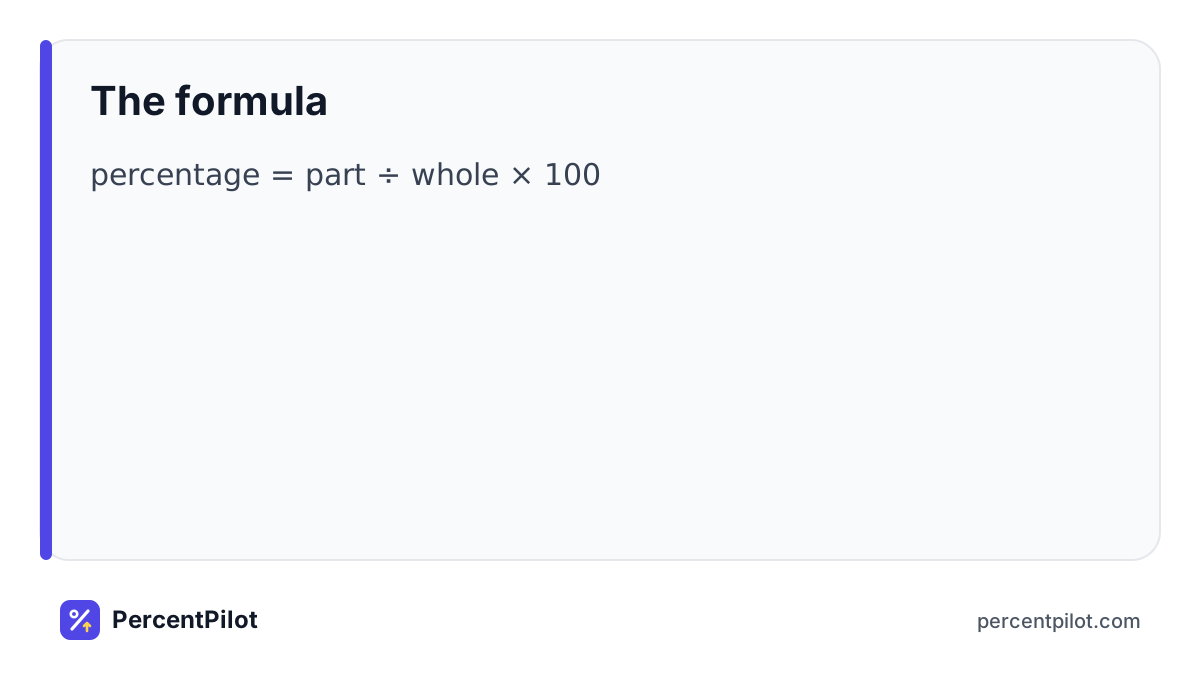
percentage = part ÷ whole × 100
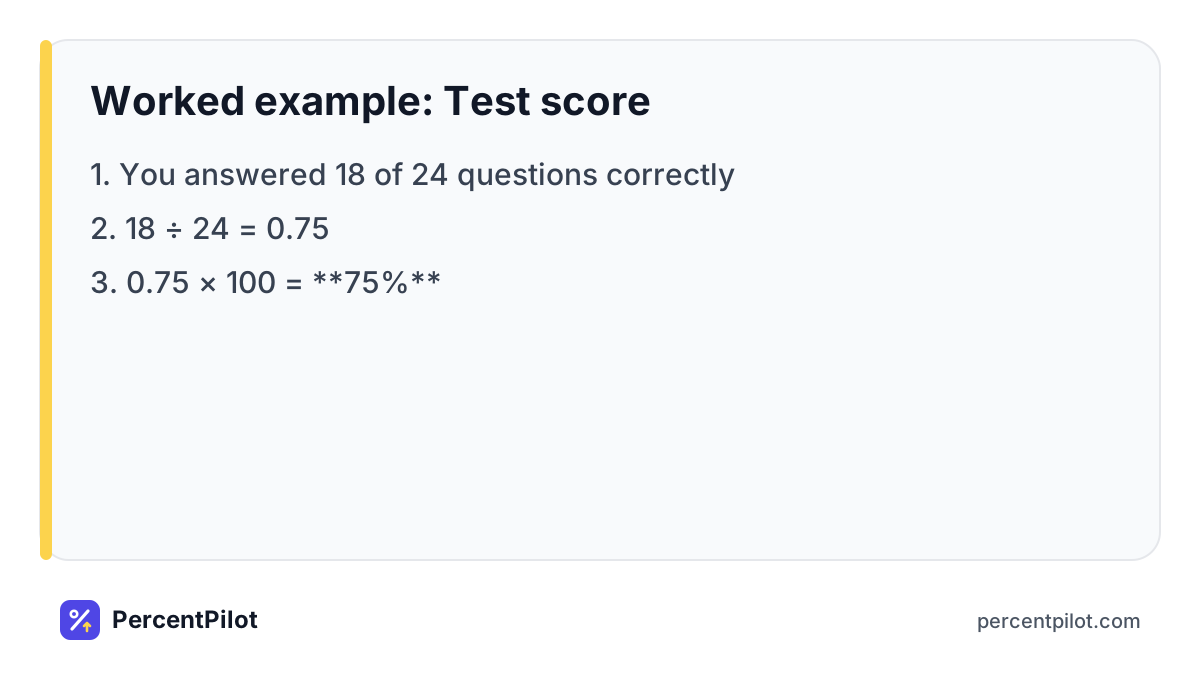
Worked example: Test score
- You answered 18 of 24 questions correctly
- 18 ÷ 24 = 0.75
- 0.75 × 100 = 75%
Worked example: Budget share
- Rent is $1,350 of a $4,500 monthly take-home pay
- 1,350 ÷ 4,500 = 0.30
- 0.30 × 100 = 30% of take-home pay goes to rent
How to find a number as a percentage in a survey
Survey results are the same calculation with bigger numbers. The “whole” is everyone who answered, and the “part” is the group you are counting.
Worked example: Survey result
- 312 of 480 people said yes
- 312 ÷ 480 = 0.65
- 0.65 × 100 = 65%
Check it backward: 480 × 65 ÷ 100 = 312. The check matters more with big numbers, because a wrong whole is easy to miss: if only 450 of the 480 people answered that question, the whole is 450, not 480, and the answer is 312 ÷ 450 × 100 = 69.33%. Always ask “out of how many?” before you divide.
Which number is the whole?
| Question | Part | Whole | Answer |
|---|---|---|---|
| 12 is what % of 48? | 12 | 48 | 25% |
| What % of 80 is 20? | 20 | 80 | 25% |
| 45 out of 60 | 45 | 60 | 75% |
| 30 is what % of 20? | 30 | 20 | 150% |
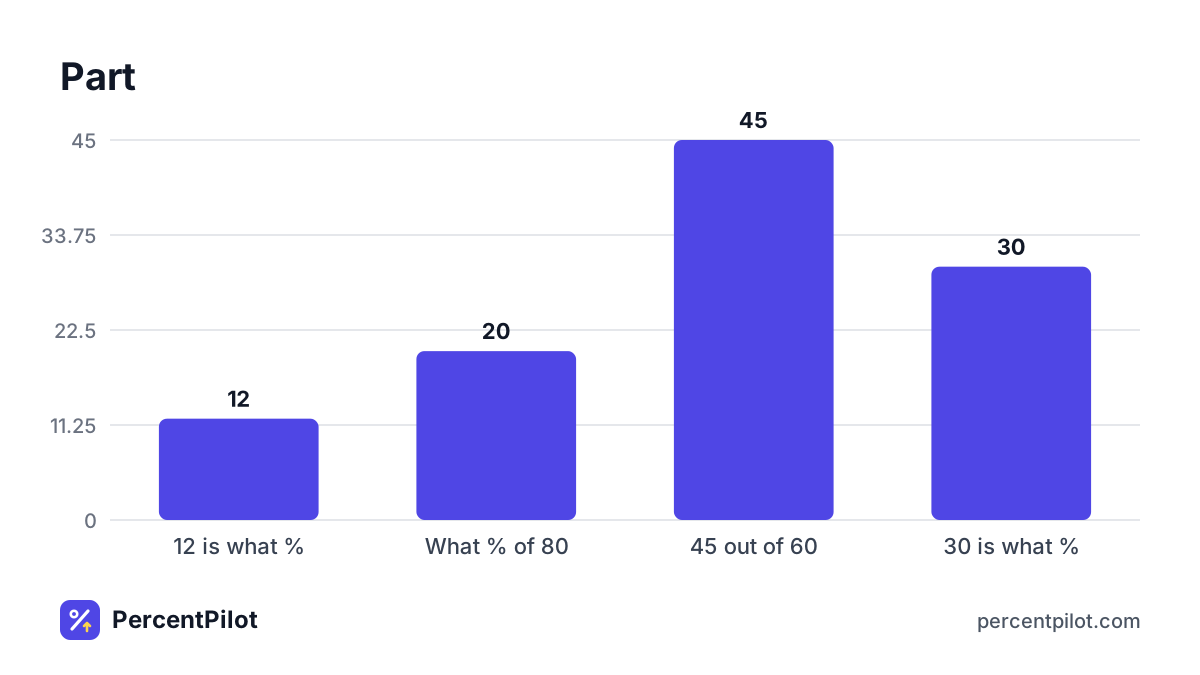
The word of points to the whole: “what percent of 80” means 80 is the whole.
When the answer is more than 100%
If the part is larger than the whole, the percentage goes above 100%. A store that sold 150 items against a goal of 100 reached 150% of its goal.
Accuracy first
Check your answer by reversing it: whole × percentage ÷ 100 should give back the part. 24 × 75 ÷ 100 = 18 ✓.
What NOT to do
- Don’t divide the whole by the part (48 ÷ 12 = 4 is a ratio, not 25%).
- Don’t forget to multiply by 100 — 0.75 is a decimal, 75% is the percentage.
- Don’t round before the final step.
More practice: how to find a percentage (every method), percentage of a number, test-score charts like out of 20, and all percentage tools.
Doing it without a calculator
Make the whole into 100 if you can. For 18 out of 25, multiply both numbers by 4: 72 out of 100, so 72%. For 7 out of 20, multiply by 5: 35 out of 100, so 35%. When the whole doesn’t divide into 100 neatly, divide the part by the whole with long division and move the decimal point two places to the right.
Where you’ll use this
This is the calculation behind test scores, survey results and budget charts. When a news story says “62 of 80 schools reported shortages”, the percentage is 62 ÷ 80 × 100 = 77.5%. When your phone says you used 9 GB of a 12 GB plan, that’s 75% of your data.
It also helps you check claims. If an ad says “1 in 4 customers switched”, that’s 25%. If a report says 300 of 1,200 people agreed and calls it “a third”, you can see it is actually 25%. Getting the whole right — the number after “of” or “out of” — is what makes the answer correct.
Practice problems (with answers)
Try each one, then check it with the Percentage Calculator. More tools: all percentage calculators.
- 27 is what percent of 36? Answer: 27 ÷ 36 = 0.75 → × 100 = 75%.
- 130 is what percent of 520? Answer: 130 ÷ 520 = 0.25 → × 100 = 25%.
- 8 is what percent of 15? Answer: 8 ÷ 15 = 0.5333 → × 100 = 53.33%.
- 75 is what percent of 60? Answer: 75 ÷ 60 = 1.25 → × 100 = 125%.
Of, off and out of: clearing up the confusion
Three small words cause most of the mistakes here. “Of” points to the whole: “what percent of 80” means 80 is the whole, so the sum is 20 ÷ 80 × 100 = 25%. “Out of” works the same way: “45 out of 60” means 45 is the part and 60 is the whole, which is 75%. “Off” is different — it means subtract: “20% off $80” is $80 − $16 = $64, not a part-of-a-whole question at all.
Two more mix-ups to watch. A ratio is not a percentage: 48 ÷ 12 = 4 is a ratio, while 12 as a percentage of 48 is 25%. And a percentage point is not a percent: a rate moving from 20% to 25% rose by 5 percentage points, which is a 25% change. In the UK the word is often written “per cent” and the subject is “maths”; in the US it is “percent” and “math” — the sums are identical.
Methodology
The method in this guide is the definition of a percentage: a number expressed as a fraction of 100, as documented in Wikipedia’s “Percentage” (accessed 2026) and explained the same way by Maths is Fun. Every worked example is built from that definition with numbers you can check by hand. Answers are rounded to two decimal places unless they come out whole, and rounding happens only at the final step — never in the middle. The whole is the total, the starting amount, or the number after “of” or “out of”. Updated: 21 November 2026.
To judge your own answer, use three checks. Work backward: whole × percentage ÷ 100 must give back the part. The answer must be under 100% when the part is smaller than the whole, and over 100% only when the part is bigger. And the same two numbers must give the same answer no matter which order you write them in the question.
Limitations: what this guide can’t tell you
This method needs a known whole. If you do not know the total — how many people were asked, how many marks were available — no percentage can be worked out honestly, and a guessed whole gives a guessed answer. Percentages also hide sample size: 65% of 20 people is 13 people, while 65% of 2,000 is 1,300. Always report the whole next to the percentage when the number matters.
Who should use this method: anyone turning a count into a share — test scores, survey results, budgets, data use. Who should not: anyone comparing a new value with an old one (that is percentage change, not a part of a whole), and anyone whose “whole” is zero or unknown. When the whole is unclear, state the raw counts instead of a percentage.
Expert review
Expert review pending. This guide was prepared by the PercentPilot Editorial Team from the definition of percentage (Wikipedia, “Percentage”) and Maths is Fun’s percentage pages. A named educator review is pending and will be noted here when it is complete.
Conclusion: how to find a number as a percentage, every time
To find a number as a percentage, divide the part by the whole and multiply by 100 — then check the answer by working backward. The whole is the number after “of” or “out of”, the answer can go over 100% when the part is bigger, and rounding waits until the final step. Get the whole right and the rest follows.
Frequently asked questions
How do I find what percent one number is of another?
Divide the first number (the part) by the second (the whole) and multiply by 100.
What is 45 out of 50 as a percentage?
45 ÷ 50 × 100 = 90%.
How do I write a number as a percentage without a calculator?
Turn it into a fraction over 100. For 18 out of 25, multiply top and bottom by 4: 72/100 = 72%.
How do I find a percentage of a total?
Divide the part by the total and multiply by 100. If 35 of 140 tickets are sold, 35 ÷ 140 × 100 = 25% are sold.
How do I turn a ratio into a percentage?
Divide the first number by the second and multiply by 100. A ratio of 3 to 5 means 3 ÷ 5 × 100 = 60%.
How do I find a number as a percentage in Excel?
Use =A2/B2 with the part in A2 and the whole in B2, then format the cell as a percentage. Excel does the × 100 step for you.
Can a percentage be more than 100%?
Yes, when the part is bigger than the whole. Selling 150 items against a goal of 100 is 150% of the goal.
Sources
Spotted an error? Tell us and we will fix it and note the change here.
PercentPilot is free — no signup, no login, and no courses sold.