
Quick answer
To find a percentage of a number, change the percent to a decimal (divide by 100) and multiply. 35% of 80 = 0.35 × 80 = 28. You can also use a fraction (25% = ¼, so 25% of 80 = 20) or build it from 10% chunks.

Key takeaways
- X% of Y = (X ÷ 100) × Y.
- Common fractions: 50% = ½, 25% = ¼, 20% = ⅕, 10% = 1/10.
- X% of Y = Y% of X — swap if it’s easier.
- Check: the answer for a percent under 100 must be smaller than the number.
On this page
Sales tax, discounts, tips, survey results — finding a percentage of a number is everyday math. Here are three ways, from calculator to mental math.
Percentage of a Number CalculatorX% of Y in one step.Open →Way 1: the decimal method
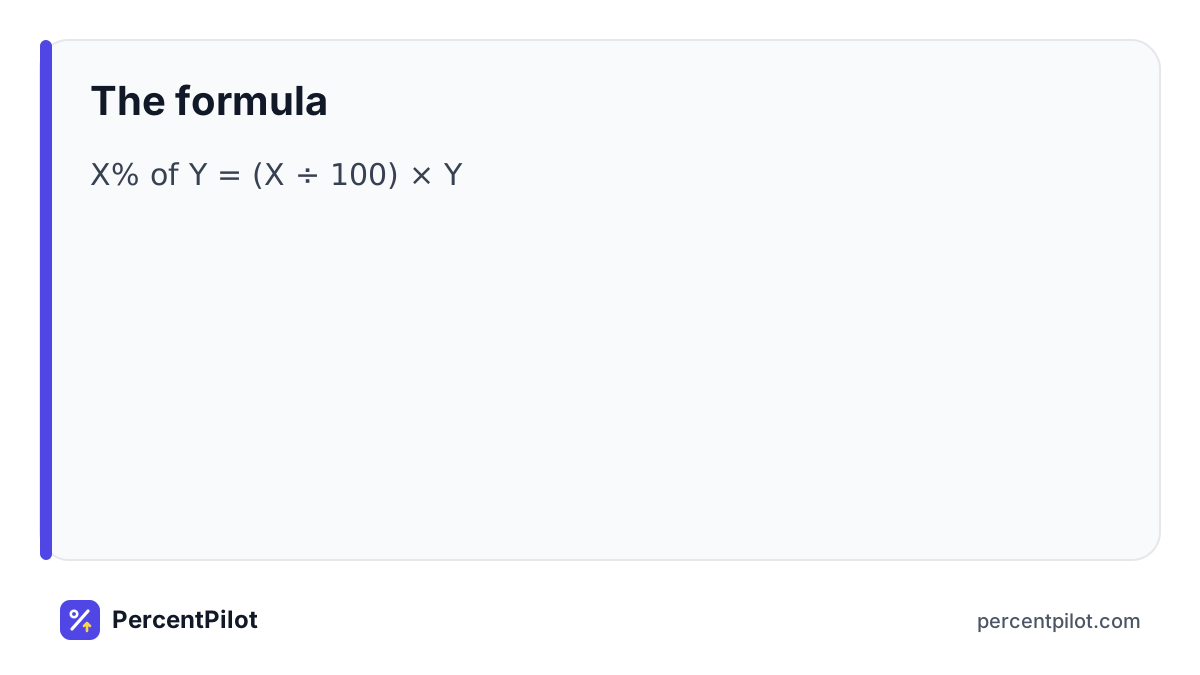
X% of Y = (X ÷ 100) × Y
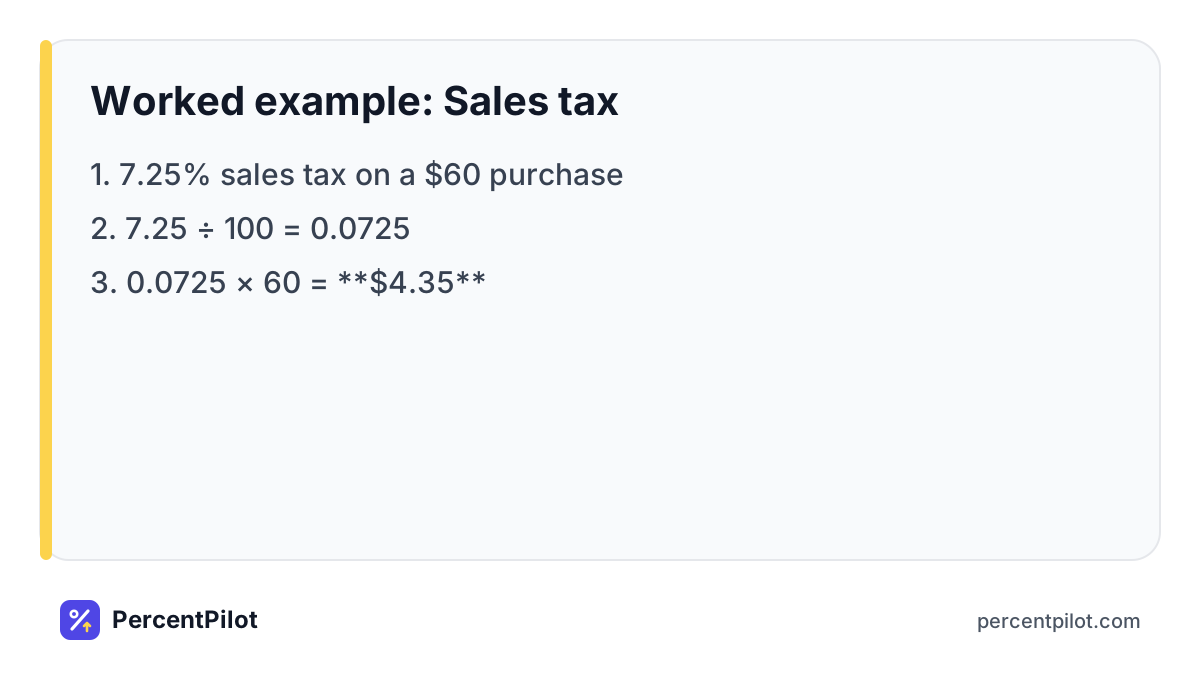
Worked example: Sales tax
- 7.25% sales tax on a $60 purchase
- 7.25 ÷ 100 = 0.0725
- 0.0725 × 60 = $4.35
Way 2: the fraction method
| Percent | Fraction | Of 80 |
|---|---|---|
| 50% | 1/2 | 40 |
| 25% | 1/4 | 20 |
| 20% | 1/5 | 16 |
| 12.5% | 1/8 | 10 |
| 10% | 1/10 | 8 |

Way 3: build it from 10%
Worked example: 35% of 80
- 10% of 80 = 8
- 30% = 3 × 8 = 24
- 5% = half of 10% = 4
- 35% = 24 + 4 = 28
The swap trick
X% of Y always equals Y% of X. So 8% of 50 is the same as 50% of 8 = 4. Pick whichever is easier.
Accuracy first
Sanity check: a percent below 100 gives an answer smaller than the starting number, and 50% must give exactly half. If 35% of 80 comes out bigger than 40, something went wrong.
What NOT to do
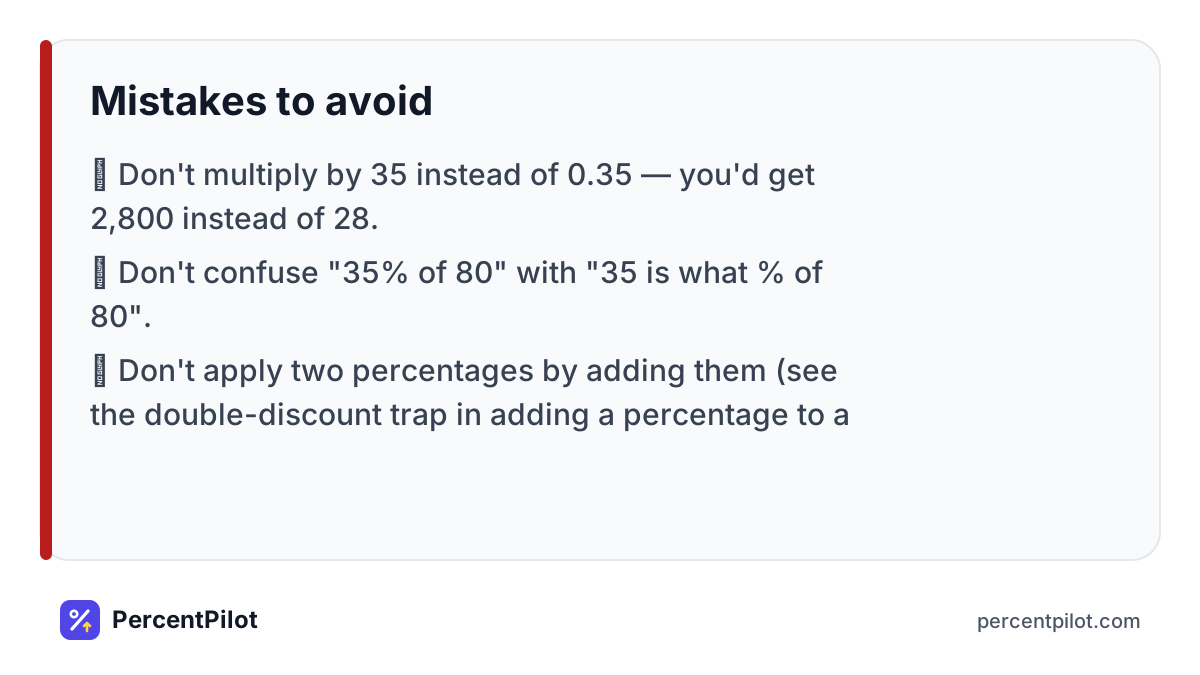
- Don’t multiply by 35 instead of 0.35 — you’d get 2,800 instead of 28.
- Don’t confuse “35% of 80” with “35 is what % of 80”.
- Don’t apply two percentages by adding them (see the double-discount trap in adding a percentage to a price).
Related: how much is 30% of 100, how to find a percentage, all percentage tools.
Percentage of a number vs. percentage increase
“Find 15% of 80” asks for a piece of 80, which is 12. “Increase 80 by 15%” asks for the new total, which is 80 + 12 = 92 — or in one step, 80 × 1.15 = 92. “Decrease 80 by 15%” gives 80 × 0.85 = 68. Read the question for the words of, increase and decrease, because each needs a slightly different calculation.
Where you’ll use this
Shopping, cooking and budgeting all use “percentage of a number”. A 25% discount on a $64 pair of shoes saves $16. A recipe that needs 40% less sugar for a smaller batch uses 0.60 × 2 cups = 1.2 cups. A budget rule that puts 20% of a $3,200 paycheck into savings sets aside $640.
At school, you’ll see it in science (40% of a 250 mL solution is 100 mL) and in statistics (12% of a sample of 500 is 60 people). In every case the method is the same: change the percent to a decimal and multiply. Then check that the answer is a sensible size.
Practice problems (with answers)
Try each one, then check it with the Percentage of a Number Calculator. More tools: all percentage calculators.
- What is 18% of 250? Answer: 0.18 × 250 = 45.
- What is 6.5% of 1,200? Answer: 0.065 × 1,200 = 78.
- What is 40% of 75? Answer: 0.4 × 75 = 30.
- What is 2.5% of 360? Answer: 0.025 × 360 = 9.
Frequently asked questions
How do I calculate 20% of a number?
Multiply the number by 0.20, or divide it by 5. 20% of 45 is 9.
What is 15% of 200?
0.15 × 200 = 30.
How do I find a percentage of a number on a phone calculator?
Type the number, press ×, type the percent and press %. Or multiply by the percent as a decimal.
How do I find a percentage of a number in Excel?
Type =B2*A2 with the percent in A2 formatted as a percentage (like 18%) and the number in B2. Excel treats 18% as 0.18.
What is 5% of 1,000?
0.05 × 1,000 = 50. A quick check: 10% of 1,000 is 100, and half of that is 50.
Sources
Spotted an error? Tell us and we will fix it and note the change here.