
Quick answer
To calculate a pay raise percentage, subtract your old pay from your new pay, divide by the old pay, and multiply by 100. Going from $62,000 to $64,480 is $2,480 ÷ $62,000 × 100 = a 4% raise. To apply a raise, multiply your pay by (1 + raise ÷ 100).
Key takeaways
- Raise % = (new − old) ÷ old × 100.
- New pay = old pay × (1 + raise %).
- Hourly to yearly: × 2,080 hours (40 h × 52 weeks).
- Compare your raise with inflation to see your real raise.
On this page
Whether you are reading an offer letter or planning to ask for more, it helps to know exactly how to calculate a pay raise in dollars and percent.
Salary Increase CalculatorRaise %, new pay and per-paycheck change.Open →The formulas
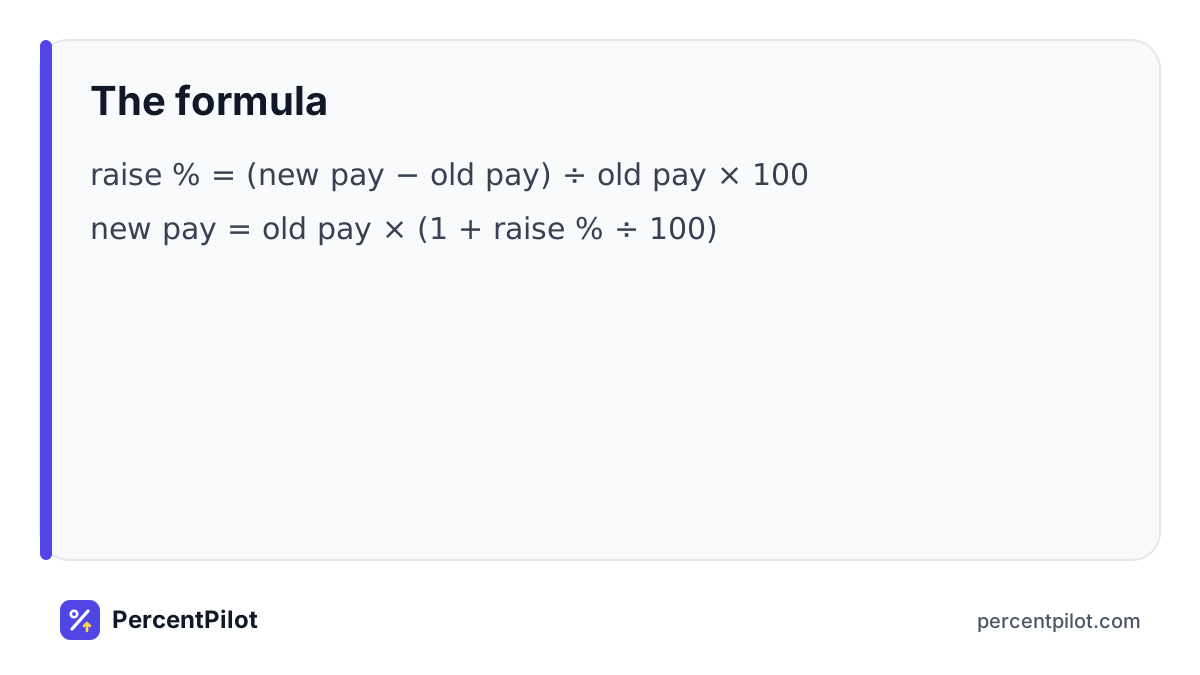
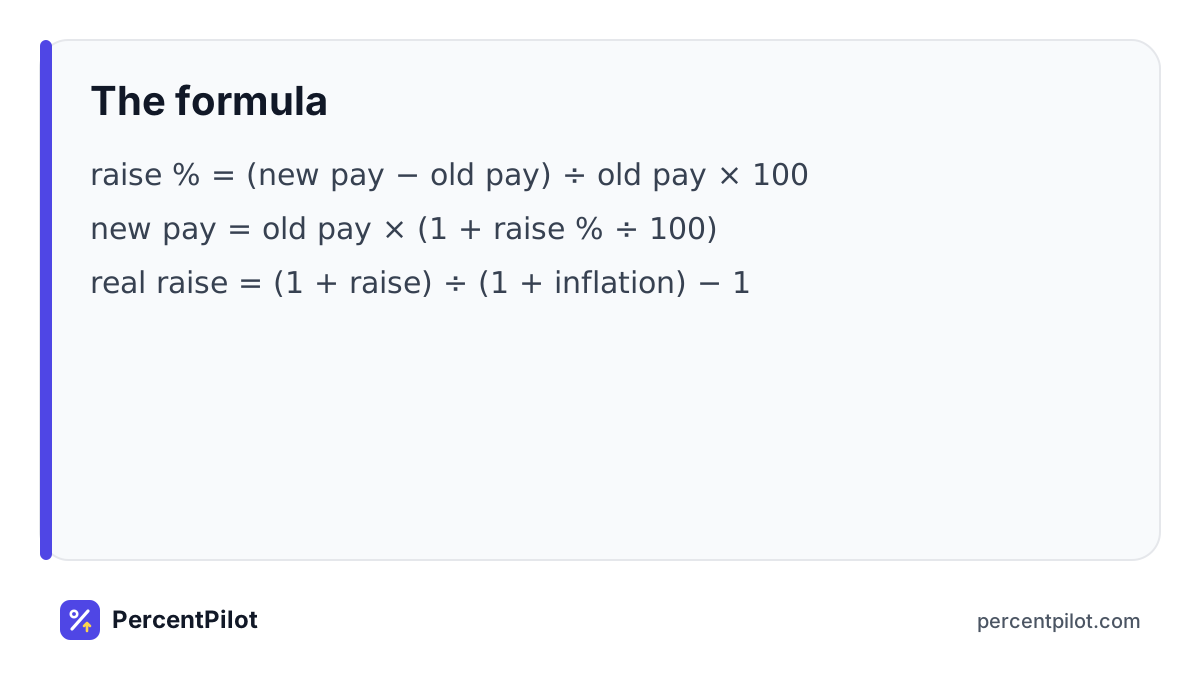
raise % = (new pay − old pay) ÷ old pay × 100
new pay = old pay × (1 + raise % ÷ 100)
Worked example: Salary raise
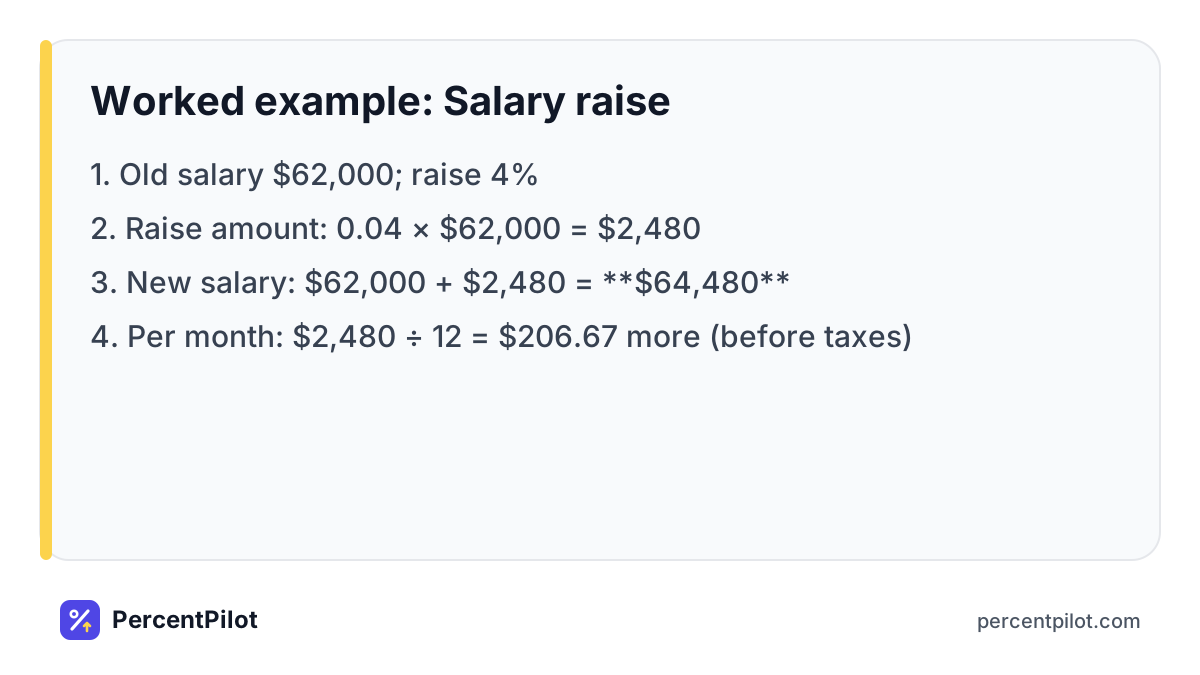
- Old salary $62,000; raise 4%
- Raise amount: 0.04 × $62,000 = $2,480
- New salary: $62,000 + $2,480 = $64,480
- Per month: $2,480 ÷ 12 = $206.67 more (before taxes)
Worked example: Hourly raise
- Old rate $22.00/hour; new rate $23.50/hour
- Raise: $1.50 ÷ $22.00 × 100 = 6.82%
- Yearly at full time: $1.50 × 2,080 = $3,120 more
What a raise looks like per paycheck
| Raise on $62,000 | Per year | Per month | Per biweekly paycheck |
|---|---|---|---|
| 2% | $1,240 | $103.33 | $47.69 |
| 3% | $1,860 | $155.00 | $71.54 |
| 4% | $2,480 | $206.67 | $95.38 |
| 5% | $3,100 | $258.33 | $119.23 |
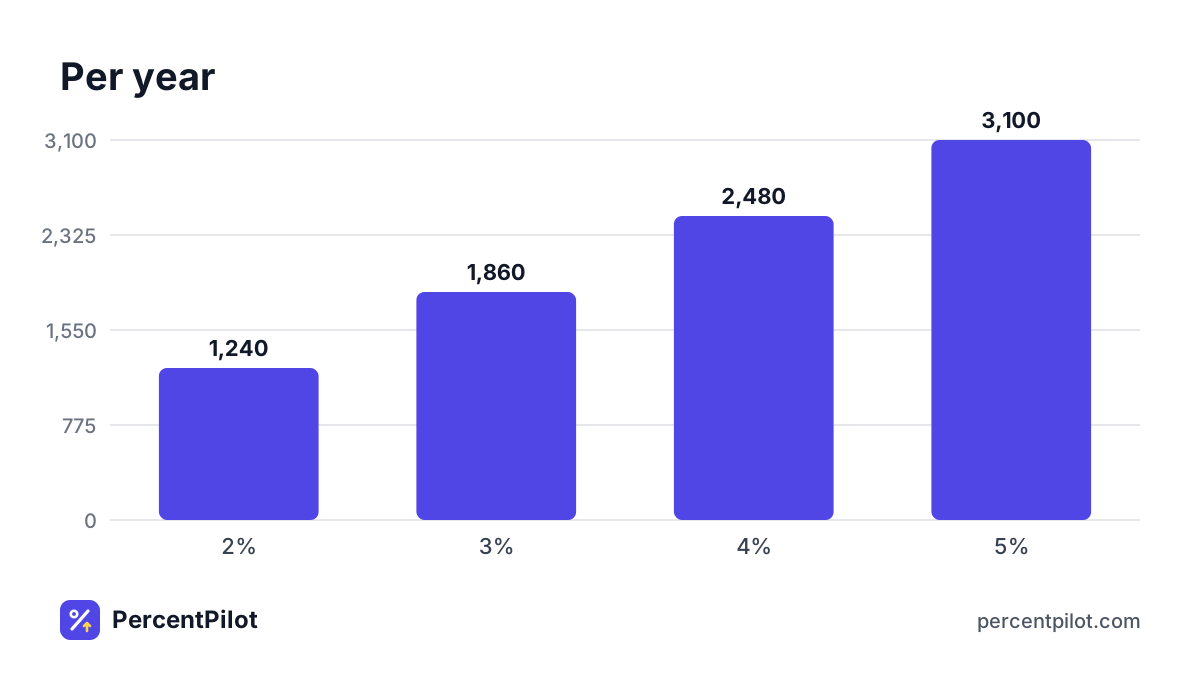
All amounts are before taxes; your take-home increase will be smaller.
Is your raise beating inflation?
Your real raise is roughly your raise minus inflation. A more exact version:
real raise = (1 + raise) ÷ (1 + inflation) − 1
With a 4% raise and 3% inflation: 1.04 ÷ 1.03 − 1 = 0.97% real raise. The Bureau of Labor Statistics publishes inflation (CPI) every month.
Accuracy first
Make sure both numbers are the same kind of pay: both yearly or both hourly, both before taxes. Mixing take-home pay with gross pay gives a wrong percentage.
What NOT to do
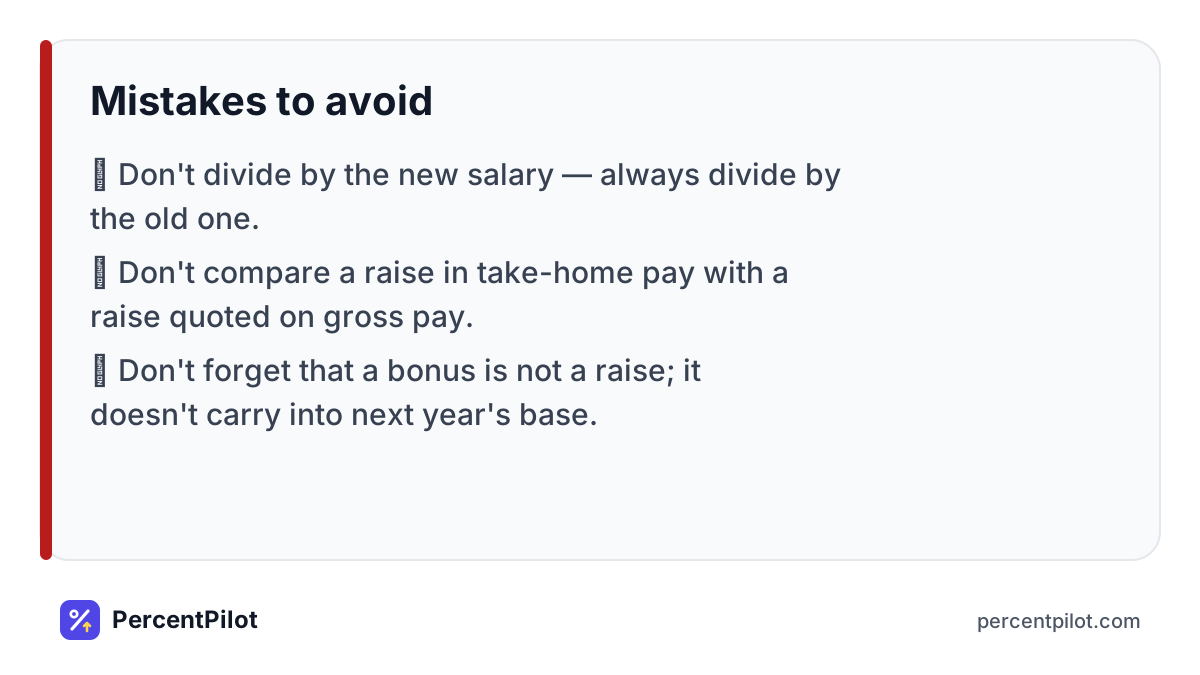
- Don’t divide by the new salary — always divide by the old one.
- Don’t compare a raise in take-home pay with a raise quoted on gross pay.
- Don’t forget that a bonus is not a raise; it doesn’t carry into next year’s base.
Related: how to add a percentage to a price, percentage change formula, all percentage calculators.
Where you’ll use this
You’ll use raise math at review time, when comparing job offers, and when negotiating. Before a review, look up the latest inflation rate from the Bureau of Labor Statistics. If prices rose 3% over the year, a 3% raise keeps your buying power the same. To actually get ahead, the raise needs to be larger than inflation.
When comparing offers, convert everything to the same unit — usually yearly gross pay — and then compare percentages. An offer of $24.50 an hour versus your current $52,000 salary is $24.50 × 2,080 = $50,960 a year, a 2% pay cut, even though the hourly number may look attractive at first.
Practice problems (with answers)
Try each one, then check it with the Salary Increase Calculator. More tools: all percentage calculators.
- A $48,000 salary gets a 3.5% raise. What is the new salary? Answer: $48,000 × 1.035 = $49,680 ($1,680 more a year, $1,680 ÷ 12 = $140 a month).
- Pay goes from $71,500 to $74,360. What is the raise? Answer: ($74,360 − $71,500) ÷ $71,500 × 100 = 4%.
- A $55,000 salary gets a 6% raise. What is the new salary? Answer: $55,000 × 1.06 = $58,300 ($3,300 more a year, $3,300 ÷ 12 = $275 a month).
Frequently asked questions
How do I calculate a 3% raise?
Multiply your pay by 1.03. On $50,000 that is $51,500 — $1,500 more per year.
What is a good raise percentage?
It depends on your field and on inflation. A raise above the current inflation rate means your pay grew in real terms.
How do I calculate a raise from hourly to salary?
Multiply the hourly change by 2,080 for a full-time year, or by your actual yearly hours.
Sources
Spotted an error? Tell us and we will fix it and note the change here.