
Quick answer
The percent composition formula gives each element’s share of a compound’s mass: % element = (number of atoms × atomic mass) ÷ molar mass × 100. In water, H₂O, hydrogen is 2.016 ÷ 18.015 × 100 = 11.19% and oxygen is 88.81%. The percentages of all the elements always add up to 100%.

Key takeaways
- Step 1: find the molar mass. Step 2: divide each element’s mass by it.
- All the percentages add up to 100% (allowing for rounding).
- Percent composition doesn’t depend on how much sample you have.
- Use standard atomic weights from the periodic table.
On this page
Percent composition shows what a compound is made of by mass. It’s used to identify unknowns, check lab results and work out empirical formulas.
Percent Composition CalculatorType a formula like C6H12O6.Open →The formula
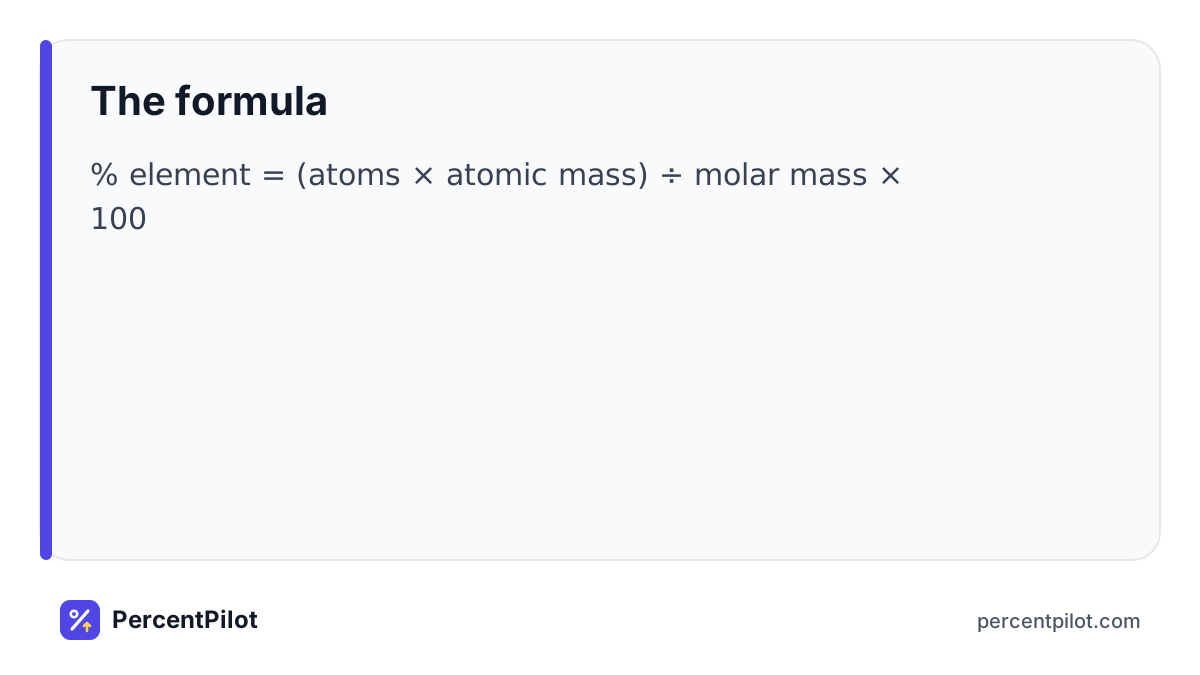
% element = (atoms × atomic mass) ÷ molar mass × 100
Worked example: Water, H₂O
- H: 2 × 1.008 = 2.016 g/mol; O: 1 × 15.999 = 15.999 g/mol
- Molar mass = 18.015 g/mol
- % H = 2.016 ÷ 18.015 × 100 = 11.19%
- % O = 15.999 ÷ 18.015 × 100 = 88.81%

Worked example: Glucose, C₆H₁₂O₆
- C: 6 × 12.011 = 72.066; H: 12 × 1.008 = 12.096; O: 6 × 15.999 = 95.994
- Molar mass = 180.156 g/mol
- % C = 40.00%, % H = 6.71%, % O = 53.28%
More results
| Compound | Element | Mass % |
|---|---|---|
| CO₂ | C | 27.29% |
| CO₂ | O | 72.71% |
| NaCl | Na | 39.34% |
| NaCl | Cl | 60.66% |
| CaCO₃ | Ca | 40.04% |
| Fe₂O₃ | Fe | 69.94% |

Using percent composition
If a sample of Fe₂O₃ weighs 50.0 g, the iron in it is 50.0 × 0.6994 = 34.97 g. Because the percentages don’t change with sample size, you can apply them to any amount.
Accuracy first
Add your percentages: they should total 100% (±0.01% from rounding). If they don’t, an atom count or an atomic mass is off.
What NOT to do
- Don’t forget subscripts outside brackets: Ca(OH)₂ has 2 O and 2 H.
- Don’t use mass numbers (like 12 or 16) when your class uses atomic weights (12.011, 15.999).
- Don’t round atomic masses to whole numbers before the last step.

Related: theoretical percentage of water in hydrates, how to calculate percentage by mass, percent yield formula.
From percent composition to an empirical formula
You can also work backward. A compound is 40.00% carbon, 6.71% hydrogen and 53.28% oxygen. In 100 g there are 40.00 g C (3.330 mol), 6.71 g H (6.657 mol) and 53.28 g O (3.330 mol). Dividing by the smallest value gives a 1 : 2 : 1 ratio, so the empirical formula is CH₂O — the simplest formula of glucose.
Where you’ll use this
Percent composition is how chemists check what a substance is. In an elemental analysis, a lab burns a sample and measures how much carbon, hydrogen and nitrogen it contains. Comparing those percentages with the theoretical percent composition of a suspected compound confirms — or rules out — the identity.
You’ll also use it on nutrition and product labels. Fertilizer bags list nitrogen as a percent by mass, and ammonium nitrate is 35.00% nitrogen by mass. That number comes straight from the formula: two nitrogen atoms (28.014 g/mol) in 80.043 g/mol of NH₄NO₃.
Practice problems (with answers)
Try each one, then check it with the Percent Composition Calculator. More tools: all science and math calculators.
- Find the percent composition of NH3. Answer: Molar mass 17.031 g/mol → N 82.24%, H 17.76%.
- Find the percent composition of C2H5OH. Answer: Molar mass 46.069 g/mol → C 52.14%, H 13.13%, O 34.73%.
- Find the percent composition of Ca(OH)2. Answer: Molar mass 74.092 g/mol → Ca 54.09%, O 43.19%, H 2.72%.
- Find the percent composition of KMnO4. Answer: Molar mass 158.032 g/mol → K 24.74%, Mn 34.76%, O 40.5%.
Frequently asked questions
What is the formula for percent composition?
For each element: (number of atoms × atomic mass) ÷ molar mass × 100.
Does percent composition change with the amount of sample?
No. A pure compound always has the same percent composition, whatever the sample size.
How do I find percent composition from masses in the lab?
Divide the mass of each element found by the total sample mass and multiply by 100.
How do I find the empirical formula from percent composition?
Assume a 100 g sample so each percent becomes grams, convert grams to moles, and divide every mole value by the smallest one to get the simplest whole-number ratio.
Why do my percentages add up to 99.99%?
That is rounding. Each percentage is rounded separately, so the total can be off by a hundredth or two.
Sources
Spotted an error? Tell us and we will fix it and note the change here.